You publish a piece on a topic you spotted trending in your feed. A week later, the analytics go the other way: traffic is flat, the SERP is stacked with six established competitors, and the search volume you were chasing peaked three weeks before you even started writing. That scenario plays out constantly in content teams, and the failure isn’t a tools problem. It’s a timing and systems problem. Most marketers find trends at the wrong moment because they have no structured way to catch early signals, or to filter which signals are worth acting on at all.
This article gives you the full system: a repeatable weekly workflow for how to find trending topics online before the window closes, a six-criteria scoring filter, and a process for turning promising signals into timely content.
The Trap of Reactive Marketing: Why Delayed Content Fails to Drive ROI
Publishing after a topic becomes saturated can make it harder to earn visibility and generate a return. You’re competing against pages that may already have relevant backlinks, established rankings, and useful coverage. Without a distinct angle, chasing late-stage trends can consume a content budget without contributing much to pipeline.
Think of this timing disadvantage as a velocity deficit: entering a trend conversation after competitors have already established useful coverage. Large companies may have more resources for content production and distribution. Smaller and mid-market teams can still compete by spotting emerging questions and answering them well while relevant coverage is limited.
The fix isn’t finding better tools. It’s auditing your current editorial calendar and asking honestly: how many of these topics are we publishing because the search volume looked attractive, rather than because we spotted the demand forming? Established search volume can still reveal valuable opportunities, but it shouldn’t be your only source of ideas. To catch emerging demand, look one layer upstream: at signals that may not yet appear clearly in keyword-volume estimates.
The Early-Signal System: 4 Layers of High-Velocity Topic Research

Finding trending content ideas before they peak means combining sources rather than relying on one dashboard. Google Trends, BuzzSumo, and social dashboards can support discovery and validation, but no single tool shows the whole picture. Pair them with first-party data, community questions, competitor activity, and AI-assisted research. Here’s how to work each layer.
1) Internal Intent & First-Party Behavioral Signals
One useful starting point is your own search data. In Google Search Console, compare the latest 14 complete days with the previous 14 and look for query clusters gaining impressions. Check clicks, average position, and which pages are appearing alongside that increase. More impressions may reflect growing demand, improved rankings, or changes to your site’s coverage, so treat the movement as a lead to investigate rather than proof of a trend. A 30% increase can be a starting flag, but always check the underlying counts: growth from 10 to 13 impressions means something different from growth from 1,000 to 1,300.
Cross-check promising queries in Google Trends using the same target region. Compare recent movement with a longer view to spot recurring seasonal patterns, and review related rising queries for emerging angles. Google Trends reports relative search interest on a 0–100 scale, not absolute search volume. Low-volume terms may show zero, so check customer questions and community discussions before dismissing them.
The second internal source is your sales, account management, and support teams. These people hear the market in real time. A question that three different prospects asked in the same week is a signal that something is shifting in how buyers are thinking about your category. Build a simple weekly habit: a dedicated Slack channel or shared doc where sales and support log new questions and objections. Review it every Monday before you touch any external topic research tool. These patterns can reveal buyer questions that public trend data hasn’t surfaced yet.
One practical example: a SaaS company’s support team starts fielding questions about a specific integration that barely existed six months ago. That spike in tickets is telling you that a segment of your market is actively trying to solve a problem your content hasn’t addressed. That’s a topic brief waiting to be written.
2) Social Conversations & Community Questions for Trending Content Ideas
Reddit, LinkedIn, Slack communities, and niche forums are where professional conversations happen before they become search queries. The friction in these spaces is a direct map of content gaps your audience is actively feeling.
The process isn’t complicated, but it requires consistency. Identify three to five communities where your target buyers spend time. Check them weekly for unanswered questions drawing engagement, recurring complaints about existing solutions, and terminology appearing more often. When you see the same language appearing across two or three separate communities in the same week, that’s a strong early signal.
Industry newsletters are an equally reliable source that most teams overlook for topic research. The people curating high-quality newsletters in your space are doing active signal detection as part of their job. When a newsletter starts testing a specific angle or theme in its subject lines, that’s a sign the curator is responding to what’s gaining traction with their audience. Subscribe to five to ten relevant newsletters and review their themes each week. A recurring angle is worth investigating, but subject lines alone don’t prove that audience demand is growing.
One important point: the goal is never to copy what competitors or curators are doing. It’s to identify the underlying demand and build something more complete, more specific, and more useful. A competitor’s post is a clue to investigate, not proof of demand. Look for an unanswered question, a clearer explanation, or original expertise you can contribute rather than assuming a longer article will perform better.
3) Tracking Competitor Changes and AI-Assisted Research
Competitors rarely announce their strategic pivots, but changes in their messaging can offer clues. A new homepage headline, blog category, or paid-ad angle may reflect a shift in positioning. If several competitors start covering the same theme, investigate what’s driving it. They may be responding to emerging demand, or simply following one another.
Set up a lightweight monitoring system: Google Alerts for your primary competitors’ brand names plus new topic terms, a shared bookmark folder where your team saves any notable competitor content changes, and a monthly review of their blog categories and landing page structures. You’re not looking for content to replicate, but for directional signals about where the market conversation is heading.
Use Google Alerts to spot new mentions and coverage. Check competitor pages directly for changes to headlines, navigation, or positioning.
This is also where AI-assisted research earns its place. Give an AI research tool a dated set of source links or excerpts and ask it to group recurring questions, identify changes, and flag conflicting evidence. Request a source and date for each finding, then verify them yourself. If the tool cannot access current sources, use it to organize the material you provide rather than identify what is trending now.
AI can handle the sorting, but your team still needs to judge what the signals mean for your brand and audience. Several articles repeating the same announcement count as one underlying signal, not independent confirmation.
4) News Cycle Monitoring and Predictive Search Behavior
Breaking news and regulatory changes generate predictable downstream search behavior. When a major industry development hits the news (a regulatory update, a high-profile acquisition, a product failure from a market leader), the questions that follow are largely predictable. Buyers and practitioners start searching for context, implications, and next steps.
For B2B brands, industry news can surface timely questions worth answering. Monitor Google News and industry news feeds daily for your category. When something significant breaks, map the second-order questions: “What does this mean for [specific role or use case]?” and “What should teams do differently as a result?” For a fast-moving story, aim to publish while those questions remain unanswered. A 48- to 72-hour turnaround can be a useful internal target when the facts are clear and expert review is available, but speed alone won’t guarantee traffic or backlinks.
The 6-Criteria Validation Filter: How to Qualify an Early-Stage Trend

Not every signal is worth acting on. Finding trending topics online is only half the problem; the other half is deciding which ones deserve your team’s resources. Without a filter, teams end up chasing every spike that looks interesting, burning production capacity on topics that fade in two weeks or never connected to their audience in the first place. This six-criteria scoring system gives you a consistent way to evaluate any trend signal before you commit to building content around it.
Use the following 1–3 rubric as a starting framework, not a validated predictor of performance. Higher scores should always mean a stronger opportunity. Prioritize topics scoring 14–18, investigate or test those scoring 10–13, and usually deprioritize those scoring 6–9. Before proceeding, require at least a 2 for audience relevance and brand authority. Review the thresholds against your own results over time.
| Criterion | 1 — Weak | 2 — Moderate | 3 — Strong |
| Trend velocity | Isolated spike or declining activity | Growth in one source, awaiting confirmation | Sustained growth supported by independent sources |
| Audience relevance | Little connection to buyers | Relevant to a secondary audience need | Directly addresses a recurring buyer question |
| Commercial fit | No clear business connection | Supports relevant awareness or education | Offers a natural next step toward a relevant solution |
| Brand authority | Little relevant expertise or evidence | Credible expertise available with further research | Direct experience, original evidence, or a qualified expert |
| Competition opportunity | Strong coverage with little room to add value | Some unanswered questions | Clear unmet intent your team can address credibly |
| Shelf life | Likely to fade before you can act | Useful long enough for a focused response | Likely to remain useful and support updates |
Velocity: Is interest increasing across comparable periods and independent sources? Review the absolute counts as well as percentage growth. A large percentage increase from a tiny baseline may be noise rather than a useful opportunity.
Audience Relevance: Does this topic directly connect to the problems, goals, or decisions of your actual buyers? A topic that’s trending broadly but has no clear connection to your target audience’s work is a distraction, not an opportunity. Filter ruthlessly here.
Commercial Alignment: Does the topic connect to a problem your business helps solve? Not every article needs an immediate sales conversion, but it should serve a clear audience and business purpose.
Brand Authority: Does your brand have existing credibility in this space, or would publishing here require you to venture into territory your audience doesn’t associate with you? Publishing outside your established authority zone requires significant additional justification to be credible.
Competition Opportunity: How many strong competitors have already published on this topic? An early-stage trend with two or three thin results is very different from one where established publications have already claimed the top positions with comprehensive content. Check the current SERP before committing.
Shelf Life: Will the topic remain useful long enough to justify the format and production effort? A brief spike may suit a social post or email, while a lasting change may justify a guide that you update over time. Match the investment to the likely useful life rather than a fixed trend category.
Run every trend signal through this filter before it enters your editorial calendar. Once the evidence is gathered, the scoring step should be quick. Use it to make prioritization more consistent rather than treating the total as a guarantee of performance.
From Signal to Published Content: A Repeatable Weekly Workflow
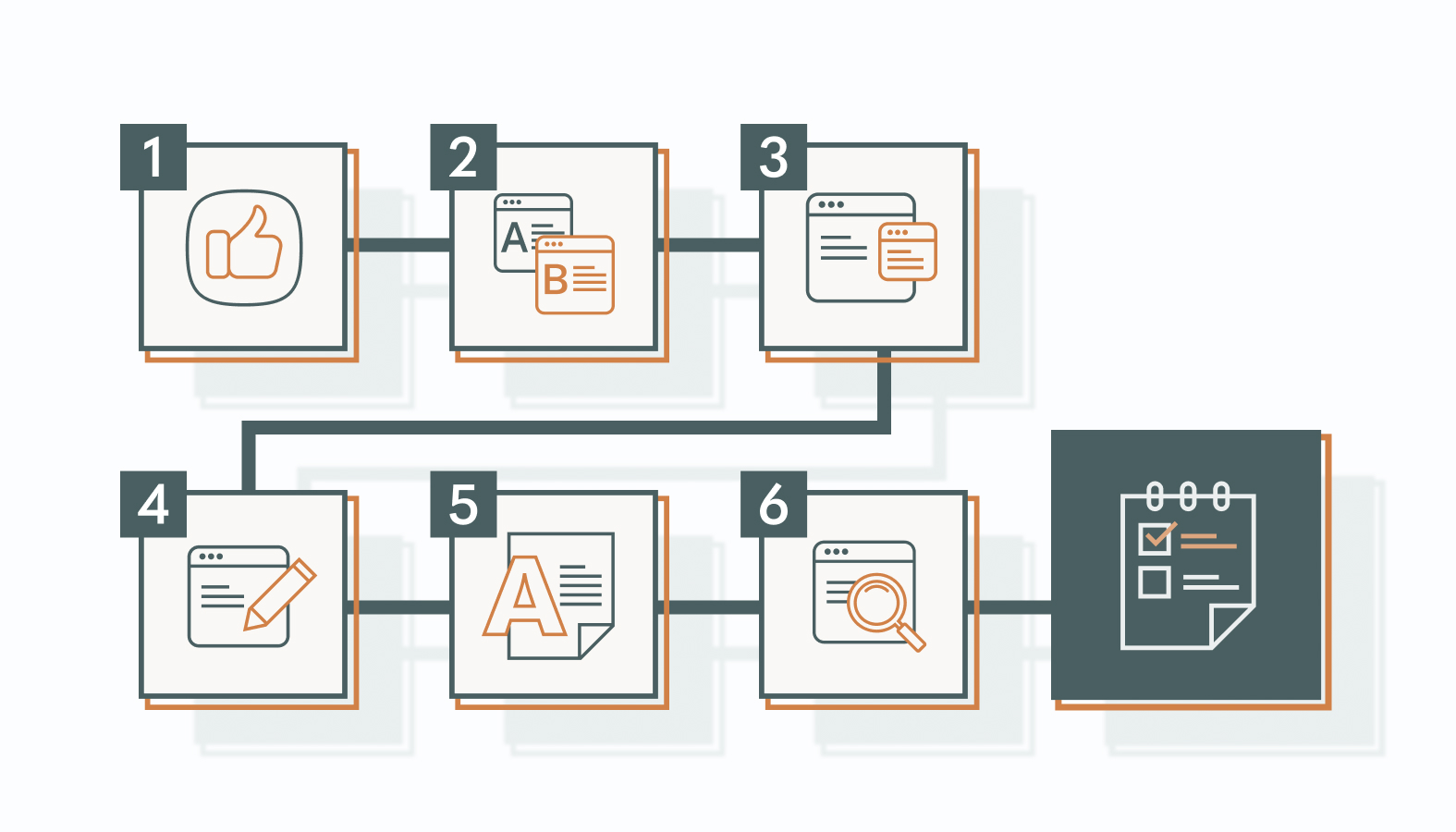
- Capture signals in one place. Each Monday, review search movement, customer questions, community discussions, newsletters, and competitor activity. Log the topic, source, date, audience question, and evidence of change. Check news more frequently when your industry requires it.
- Cross-check and score. Look for support from at least two independent sources where possible. Separate recurring seasonal demand from new growth, then apply the six-criteria filter. One authoritative announcement may justify a timely response, but it doesn’t establish a wider trend.
- Check your existing coverage. Search your content inventory for the same question and intent. Update an existing page when it already serves that need. Create a new piece when the emerging question warrants a distinct answer.
- Write a focused brief. Define the reader, the question, why it matters now, your original contribution, the supporting sources, and the next step for readers. Choose a format that fits the topic’s useful life, then assign an owner, reviewer, and deadline.
- Publish while the answer is useful. Complete factual and editorial checks, then distribute through relevant channels such as email, social, and sales enablement. For short-lived topics, don’t rely solely on organic search to reach readers in time.
- Review and recalibrate. Check early engagement after publication and revisit search performance and business outcomes as data accumulates. Record which signals produced useful content, update pieces as facts change, and use those results to improve the next round of scoring.
FAQs About How to Find Trending Topics Online
1) How long does a trending topic typically last before it becomes irrelevant?
There’s no fixed lifespan. A news-driven spike may fade within days, while an industry shift can create questions for months or years. An algorithm update may trigger a short burst of discussion while leaving practical questions that remain relevant much longer.
Check whether interest is sustained, recurring, or tied to one event. Use that evidence to choose the format and investment. Long-form content can serve lasting trends, but it can also answer evergreen questions that were never trending.
2) Is it worth paying for premium trend platforms like SparkToro or Exploding Topics?
Potentially, but start with the research gap you need to fill. SparkToro is primarily an audience research tool that helps you understand where audiences spend time and what interests them. Exploding Topics focuses on identifying emerging trends. They serve different roles in the research process.
Before paying, test whether the tool surfaces relevant opportunities you would otherwise miss, saves meaningful research time, and fits your production workflow. A slow approval process can limit the value of fast-moving signals, but publishing within two weeks does not guarantee a return. Compare the subscription and production costs with the results your team actually achieves.
3) What are the risks of creating content around short-lived or controversial trends?
The primary risk is brand dilution. When a brand publishes content around a viral trend or controversy without a clear, logical connection to its actual expertise, the content reads as a reach, and experienced buyers notice. In B2B particularly, where trust and credibility drive purchase decisions, hollow trend-chasing erodes the authority your content program is supposed to be building. A mid-market executive evaluating vendors doesn’t become more likely to engage with your brand because you published a hot take on a trending news story that has nothing to do with your category.
The second risk is audience alienation. Your subscribers and regular readers have a clear expectation of what your brand covers and how it covers it. Content that falls outside that expectation, especially content that seems motivated by traffic rather than genuine expertise, signals to your audience that your editorial standards are inconsistent. That erodes the trust that makes content marketing valuable in the first place. The rule is straightforward: if you can’t draw a logical line from the trend to your brand’s core expertise without stretching, don’t publish it.
Scale Your Organic Pipeline
Early trend capture isn’t a creative instinct or a lucky catch. It is an operational system built from consistent habits, the right data sources, and a filter that keeps your team from wasting production capacity on signals that don’t convert. The brands that consistently publish ahead of the curve aren’t more creative than their competitors. They have a repeatable process for how to find trending topics online, and they’ve built the internal infrastructure to act on signals fast enough to matter.
Most mid-market teams have the intent but not the architecture. The research habits aren’t consistent, the scoring criteria don’t exist, and the connection between trend detection and content production is loose at best. That’s the gap that turns a promising content program into a reactive one: always chasing, never leading.
If your organic pipeline isn’t generating the momentum your growth targets require, it’s worth reviewing how your team finds, evaluates, and acts on content opportunities. Schedule a candid conversation with one of our experts. Bring your current content setup, your pipeline goals, and your biggest editorial bottlenecks, and we’ll give you a clear read on where the system breaks down and what’s worth fixing first.