


Most marketers know that acquiring a new customer costs significantly more than retaining an existing one. The challenge isn’t understanding the math—it’s building a customer lifecycle marketing strategy that consistently improves retention and customer lifetime value. However, understanding the economics and implementing an effective customer lifecycle marketing system are two very different things.
If your retention numbers are quietly sliding while your acquisition spend keeps increasing, no amount of new leads fixes the problem. According to Harvard Business Review, acquiring a new customer is anywhere from five to 25 times more expensive than retaining an existing one. In B2B organizations, losing even one high-value account can erase months of acquisition investment, making customer retention a critical driver of long-term profitability.
Many B2B organizations describe their retention marketing efforts as customer lifecycle marketing, yet they rely on disconnected campaigns that fail to create a cohesive customer journey. That gap wastes ad spend and lowers your customer lifetime value, deal by deal, month after month. This guide covers the specific structural mistakes causing that loss, and what an actual lifecycle system looks like once it’s fixed.
What is Customer Lifecycle Marketing? (And Why Most B2B Brands Get It Wrong)
Customer lifecycle marketing is the strategy of delivering personalized, data-driven communications throughout every stage of the customer journey—from awareness and acquisition to onboarding, adoption, retention, renewal, and advocacy.
You’ve probably built lead nurturing sequences before, which is a different thing. Lead nurturing gets someone to say yes. Customer retention marketing keeps them saying yes through onboarding, product adoption, expansion, and renewal.
Most B2B brands get this wrong by treating retention as a feeling instead of a discipline. You can’t run a real lifecycle program on instinct. It has to be anchored in actual usage data, churn signals, and revenue impact, or you’re just guessing with better branding. Most customer lifecycle marketing failures fall into three categories.
Strategic Pitfalls: Where Retention Marketing Systems Fail
Retention marketing systems fail in three places: the infrastructure, the messaging built on that infrastructure, and the organizational alignment behind both.
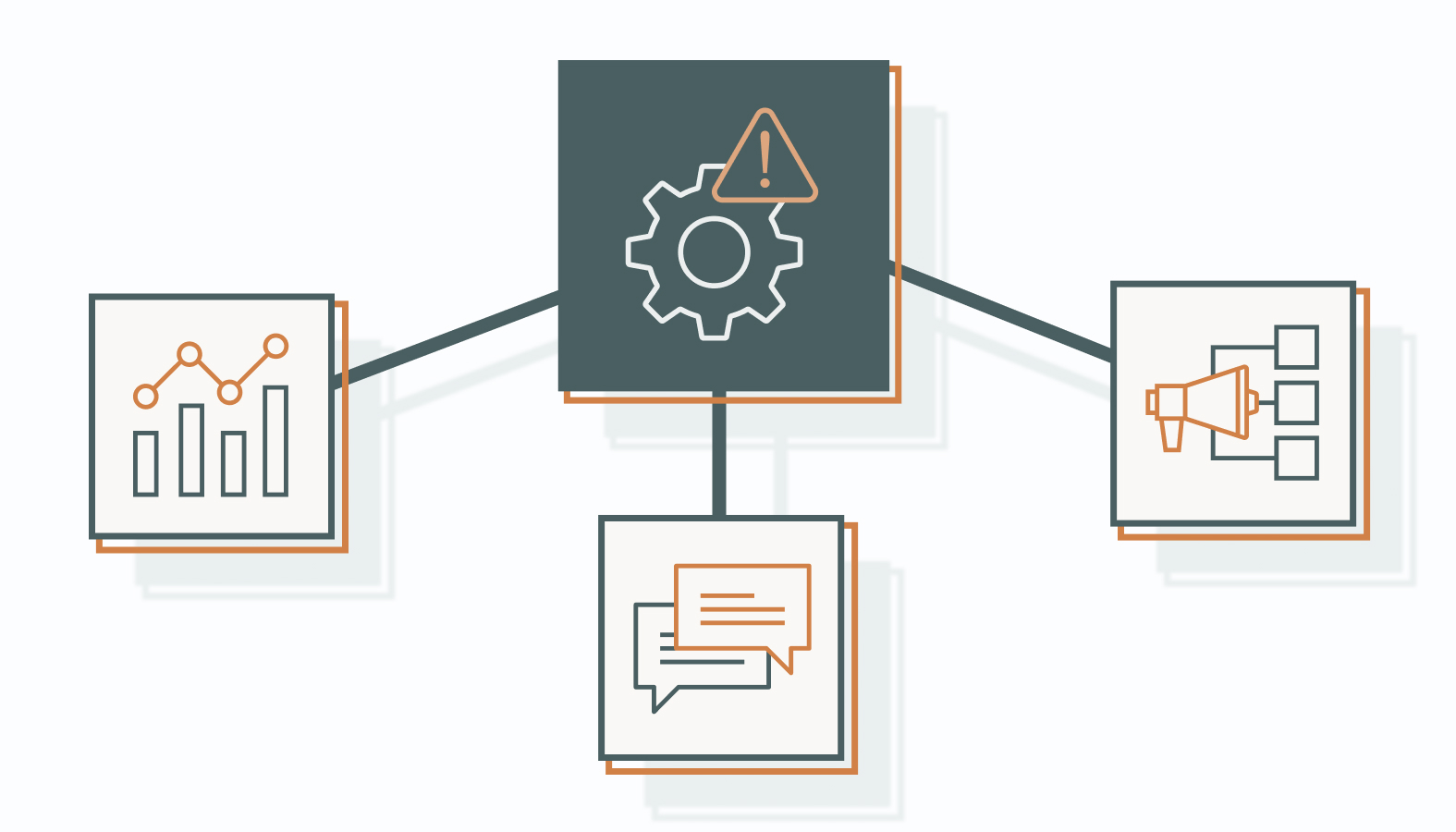
Category 1: Infrastructure and Data Friction
Before you can fix messaging, you have to fix what’s feeding it. Most retention problems start here, quietly, long before a customer ever complains.
Siloed Systems and Fragmented Data
When your CRM doesn’t connect to your marketing automation platform, and neither connects to your support system, your customer feels it directly. They get a renewal email the same week they filed a complaint nobody resolved. You didn’t plan that. Your systems weren’t connected.
This isn’t a minor technical inconvenience. According to Salesforce’s State of the Connected Customer report, 84% of customers say the experience a company provides is as important as its products or services. Every disconnected system loses context about the customer. That lost context shows up later as a bad experience, even if the customer can’t say exactly why the interaction felt off.
Ignoring Early Churn Signals
A customer rarely leaves without warning you first. Common churn indicators include declining product usage, fewer logins, reduced feature adoption, declining purchase frequency, and lower customer engagement. If you’re not tracking that behavioral data before their cancellation, you’re not managing retention. You’re just reacting to it too late to change the outcome.
The teams that catch churn early aren’t smarter. They just decided in advance which behaviors count as a warning sign, then built a workflow that flags those behaviors automatically instead of noticing a pattern by accident during a quarterly review.
Tracking Vanity Metrics Over Revenue Metrics
Metrics like email open rates and impressions can look encouraging, but they rarely indicate whether accounts are expanding or generating additional revenue. If your dashboard leads with engagement instead of pipeline and expansion revenue, you’re measuring activity, not results.
An account can open every email you send and still quietly shrink its usage every month. Engagement metrics measure whether someone is paying attention to your emails. Revenue metrics measure whether the relationship is growing. These metrics answer two very different business questions and shouldn’t be confused.
Category 2: Messaging and Relationship Strategy
Even a perfectly connected data stack fails if what you send with it doesn’t respect the relationship you have with the customer.
Treating Existing Customers Like New Prospects
If every email to an existing customer pitches a new tier or a new feature, you’re treating them like a prospect who hasn’t bought yet. A customer who hasn’t fully adopted what they paid for doesn’t need a bigger pitch. They need help getting value from the thing they already own.
Lazy Segmentation and “Batch” Communication
Sending the same product update to your entire customer base, regardless of role, use case, or how long they’ve been a customer, tells everyone on that list you don’t know who they are. A workflow built around role and behavior takes more setup. It also gets read. Mailchimp’s analysis of 11,000 segmented campaigns found that segmented sends generated 100.95% higher click rates than non-segmented campaigns sent to the same audiences.
A finance buyer and the end user on the same account care about completely different things from the same product update. One workflow can’t serve both well. Trying to write copy vague enough to apply to everyone usually means nothing to anyone.
Mismanaging Omni-Channel Orchestration
Email, SMS, and retargeting ads all reaching the same customer in the same week, with no coordination between them, isn’t attentiveness. It’s simply noise. Optimove’s Marketing Fatigue Report found that 70% of consumers unsubscribed from at least three brands in the past three months due to excessive messaging. Without a shared frequency cap across channels, you’re multiplying your customer’s reasons to tune you out.
Category 3: Organizational Alignment
Even good data and messaging fail if the teams responsible for the customer relationship aren’t working from the same playbook. According to Gartner’s survey of sales leaders, organizations with aligned sales, marketing, and customer success teams consistently achieve stronger customer retention and revenue growth.
The Sales-to-Success Handoff Gap
Whatever your sales team promised during the deal has to show up in onboarding, or the customer’s first real experience with your company is an unmet promise. This gap is one of the most common, and most preventable, sources of early churn.
The fix isn’t complicated, but it requires discipline: every commitment made during the sales cycle needs to travel with the account into onboarding, documented somewhere in customer success, not buried in a sales rep’s personal notes.
Setting Unrealistic, Short-Term Timelines
A lifecycle email sequence doesn’t fix a broken product experience. Expecting it to within a month makes the whole program look like it failed, when the real problem was somewhere else.
Customer Lifecycle Marketing Examples That Increase Customer Lifetime Value
The strongest lifecycle marketing examples share one trait: they respond to actual customer behavior instead of running on a fixed calendar.
The Behavioral Segmentation Framework
Instead of sending the same onboarding sequence to everyone, split customers into two tracks based on usage:
- customers engaging heavily
- customers whose activity is already dropping
The second group needs help, not the same generic check-in email the first group gets.
In practice, this means setting specific thresholds ahead of time:
- what counts as heavy engagement
- what counts as a warning sign
- what automated response triggers when a customer crosses one category to another
Without those thresholds defined in advance, segmentation stays a slide in a strategy deck instead of something your systems do.
The Seamless Post-Purchase Onboarding Journey
One of the strongest lifecycle marketing examples is behavior-triggered onboarding, where messaging changes based on customer actions rather than a fixed schedule. A customer who logs in immediately and starts using core features needs different content than one who hasn’t logged in at all.
The Automated B2B Win-Back Campaign
Closed-lost opportunities and past customers aren’t dead ends. Build win-back campaigns around what has specifically changed since the customer left. A new feature, pricing update, or resolved concern converts far better than a generic “We miss you” email.
The key detail is specificity. If the reason a prospect left eighteen months ago has since been fixed, that’s the entire message. Not a general product update. The exact objection, addressed by name, is what gets a former prospect to reconsider a conversation they’d already closed.
How to Audit and Fix Your Lifecycle Marketing Strategy
Fixing a broken lifecycle strategy starts with mapping what’s happening today, not designing what you wish were happening.
Step 1: Map Data Pipelines
Document every source of customer data across marketing, sales, and support. Trace exactly how it flows, or doesn’t flow, between systems. Most teams discover gaps here they didn’t know existed: a support flag that never reaches marketing, a usage metric that never reaches sales.
Fix that unification because nothing else in your lifecycle strategy works until this layer is solid.
Step 2: Audit the Current Post-purchase Experience
Walk through your actual post-purchase journey as if you were the customer: the follow-up emails, any loyalty program, every support touchpoint. Most audits turn up the same weaknesses: gaps of silence right after purchase, generic content, and missed moments where a quick check-in would have caught a problem early.
Write down every single touchpoint a customer has with your company in their first ninety days, in order, with dates. Most teams have never done this, and it tends to surface silence gaps and redundant messages nobody had noticed.
Step 3: Establish an Experimentation Framework
Lifecycle marketing isn’t something you set once and leave behind. Build a structured testing process, A/B or multivariate, around specific hypotheses tied to specific metrics.
Test one variable at a time, document what you learn, and feed those learnings directly into the next campaigns instead of starting over each time.
Step 4: Leverage Fractional Expertise
Not every team has a data analyst or CRM strategist on staff, and building that skill set from scratch takes months. Organizations without in-house CRM or lifecycle specialists may benefit from outside expertise when implementing complex automation or segmentation projects. This doesn’t need a full-time hire for work that may not need to be full-time.
This works especially well for one-time or periodic projects: standing up a new CRM integration, rebuilding a segmentation model, or diagnosing why a specific cohort keeps churning. Those are the situations where a specialist can move faster than a generalist team learning the skill on the job, and where a permanent hire wouldn’t have enough ongoing work to justify the role.
FAQs About Customer Lifecycle Marketing
1) What is the difference between customer lifecycle marketing and traditional email marketing?
Traditional email marketing is campaign-based: a single channel, sent on a schedule, largely the same message to everyone. Customer lifecycle marketing coordinates multiple touchpoints and personalizes messaging based on each individual, not where the calendar says they should be.
2) How does retention marketing directly impact corporate profitability and ROI?
Even a small increase in retention rate compounds significantly over time, since retained customers cost far less to keep than new customers cost to acquire. They tend to spend more as the relationship matures. Customer retention marketing creates repeatable processes that increase customer lifetime value, improve expansion revenue, and reduce acquisition costs over time.
3) What tools are required to build an elite customer lifecycle marketing framework?
Most organizations build customer lifecycle marketing programs using a CRM, marketing automation platform, customer data platform (CDP) or analytics solution, behavioral tracking tools, and customer feedback systems. Many lifecycle marketing examples rely on these platforms working together rather than individually.
4) Who should own the customer lifecycle within a B2B organization?
No single department owns it independently. Marketing, sales, and customer success all touch the relationship at different points. This is exactly why cross-functional accountability matters more than assigning it to one team. Successful customer lifecycle marketing typically has executive ownership with shared KPIs across marketing, sales, customer success, and product teams.
Fix Your Retention Systems or Waste Your Ad Spend
Real retention marketing is infrastructure, not email blasts with better subject lines. Once the data is unified, the segmentation is real, and the teams are aligned, retention becomes something you can measure and improve, quarter over quarter.
The operational return on a properly built lifecycle system usually shows up faster than teams expect, because you’re not spending more to acquire customers you have failed to keep. Every fix outlined here, such as unifying the data, tracking churn signals, aligning sales and success, compounds together. None of them work well alone, but altogether, they turn retention from a lagging metric into something you actively manage in real time.
If you want a second set of eyes on your current setup, explore Agency’s Marketing Automation & Operational Efficiency services, or schedule a candid conversation with one of our experts » to audit your current growth stack. We’ll review your current lifecycle strategy, identify retention gaps, and recommend practical improvements based on your existing systems and business goals.