


A well-designed RevOps strategy can help reduce waste in six-figure marketing and sales budgets caused by disconnected processes, inconsistent data, and inefficient handoffs. Marketing hits its lead targets. Sales still misses quota. Nobody can point to the exact place where the disconnect happens, so the same budget gets spent again next quarter, hoping for a different result. Meanwhile, the two teams may work from separate dashboards and priorities, making it difficult to identify where the revenue process is breaking down.
Revenue Operations (RevOps) is a cross-functional operating model that aligns marketing, sales, customer success, data, and technology around revenue goals. It’s a data-driven operating framework built to connect lead generation, sales execution, customer retention, and revenue outcomes, so revenue-generating teams work from consistent data, processes, definitions, and performance goals.
This guide walks you through the core pillars of a RevOps strategy, how to identify revenue funnel bottlenecks, and a practical framework for addressing them.
The Core Pillars of an ROI-Centric RevOps Strategy
An ROI-centric RevOps strategy depends on three interconnected areas: people, processes, and technology. Addressing only one area can produce limited improvements if any of the underlying areas remain misaligned.
People
When sales and marketing operate with separate goals, definitions, and incentives, misalignment can create inefficiencies across the revenue funnel. Pulling both teams out of isolated silos and aligning them under one shared revenue target changes what gets prioritized in weekly meetings.
When marketing is primarily measured on lead volume while sales is measured on closed revenue, each team can optimize for different outcomes even when both are working toward the same business goal. This isn’t about bad faith. They’re just following the incentive structure they were actually given, not the one leadership assumes is in place.
Process
Inconsistent or undocumented processes make revenue operations dependent on individual judgment rather than repeatable workflows. A RevOps strategy replaces that inconsistency with documented Standard Operating Procedures that define lead get handoffs, follow-up requirements, and ownership at each stage.
Without documented ownership and handoff procedures, execution becomes inconsistent and difficult to scale.
Technology
Your CRM and marketing automation platform should share the data, definitions, and workflows needed to create a consistent view of the customer journey. That way, a lead’s status means the same thing to both teams, instead of marketing calling something “qualified” that sales still considers raw.
Inconsistent definitions can create friction between teams, particularly when marketing and sales use different criteria for qualification.
Diagnosing Your Leaky Funnel: Common Revenue Bottlenecks
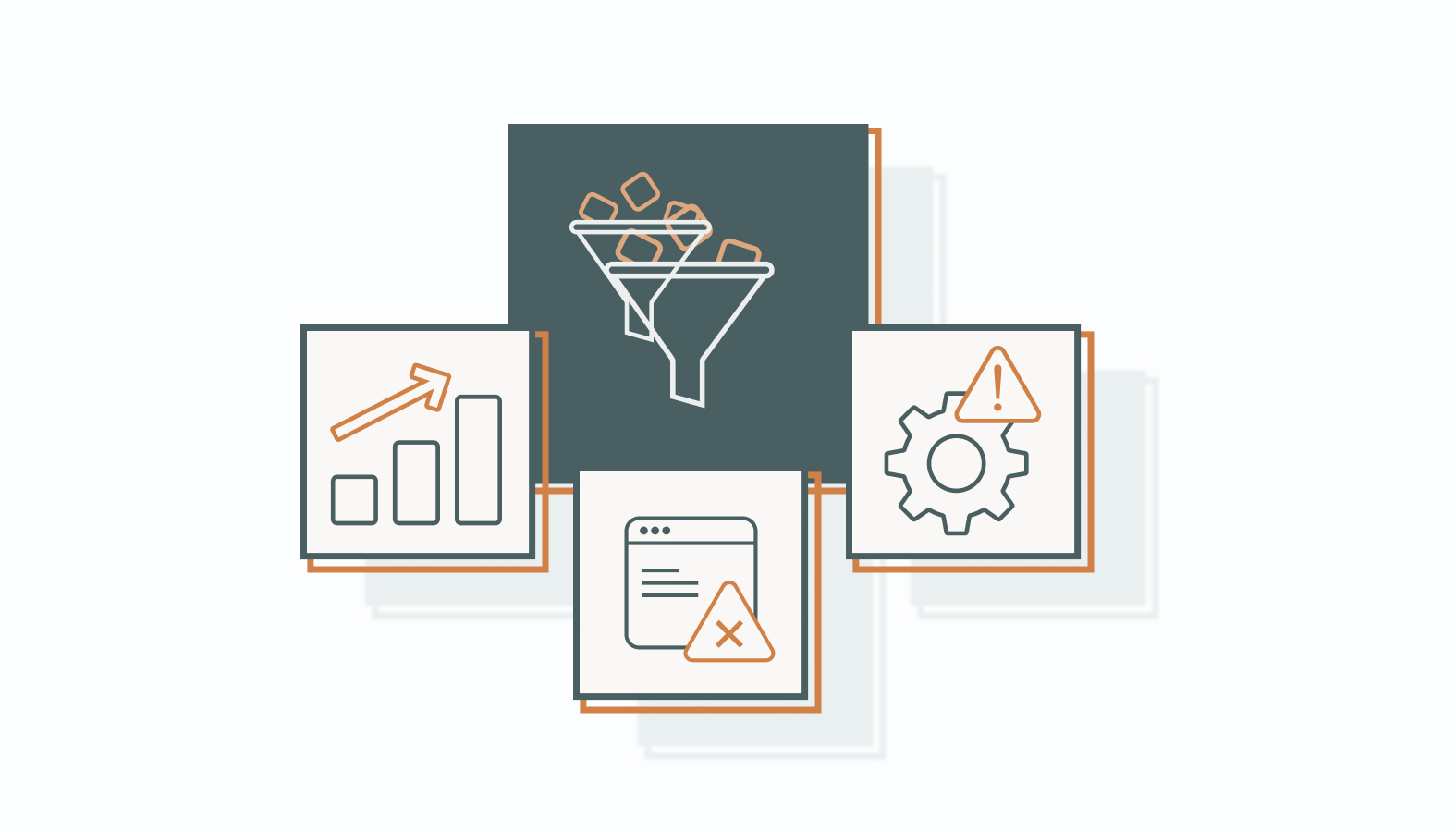
Revenue funnel leakage typically becomes visible in three areas: poorly defined metrics, unreliable data, and inefficient handoff between teams.
Leaders may recognize that performance is deteriorating before they can identify the underlying bottleneck. Without a clear diagnosis, teams risk continuing to invest in a process without addressing the source of the problem.
The “Vanity Metric” Trap
Marketing may record lead volume while sales sees low engagement or qualification rates among those leads. Both perspectives can be valid because lead volume and lead quality measure different aspects of funnel performance.
Lead volume alone provides limited insight into funnel health unless it is evaluated alongside qualification, conversion, and revenue outcomes. Lead volume and lead qualityshould be evaluated separately, then connected to downstream conversion and revenue outcomes.
Inconsistent Data
When your tools don’t connect, you lose the ability to see the true customer journey or calculate an accurate customer acquisition cost. Salesforce’s research found that 76% of customers expect consistent interactions across departments, while 54% report that sales, service, and marketing do not appear to share information effectively.
When customer interactions are distributed across disconnected systems, teams may struggle to attribute revenue accurately across the buyer journey. The CAC figure leadership reviews each quarter may be incomplete or inaccurate if customer interactions and acquisition costs are not consistently captured across systems.
Friction at the Handoff
Leads can stall when routing, scoring, or ownership processes are unclear, and the cause is not always a lack of buyer interest. It’s because there’s no automated routing, no lead scoring, and no clear accountability for who’s supposed to act next. Research published by Harvard Business Review found that organizations responding to leads within an hour were substantially more likely to qualify them than organizations that waited longer.
A lead sitting untouched because no team or individual owns the next action is an operational problem, not simply a sales or marketing problem. It’s a process failure that shows up looking like both, and both teams end up blaming each other for something neither team owned.
How to Run a Funnel Audit
A funnel audit identifies where prospects slow down, convert at lower-than-expected rates, or become difficult to track across systems. Skipping the diagnostic work can lead teams to address symptoms rather than the underlying cause.
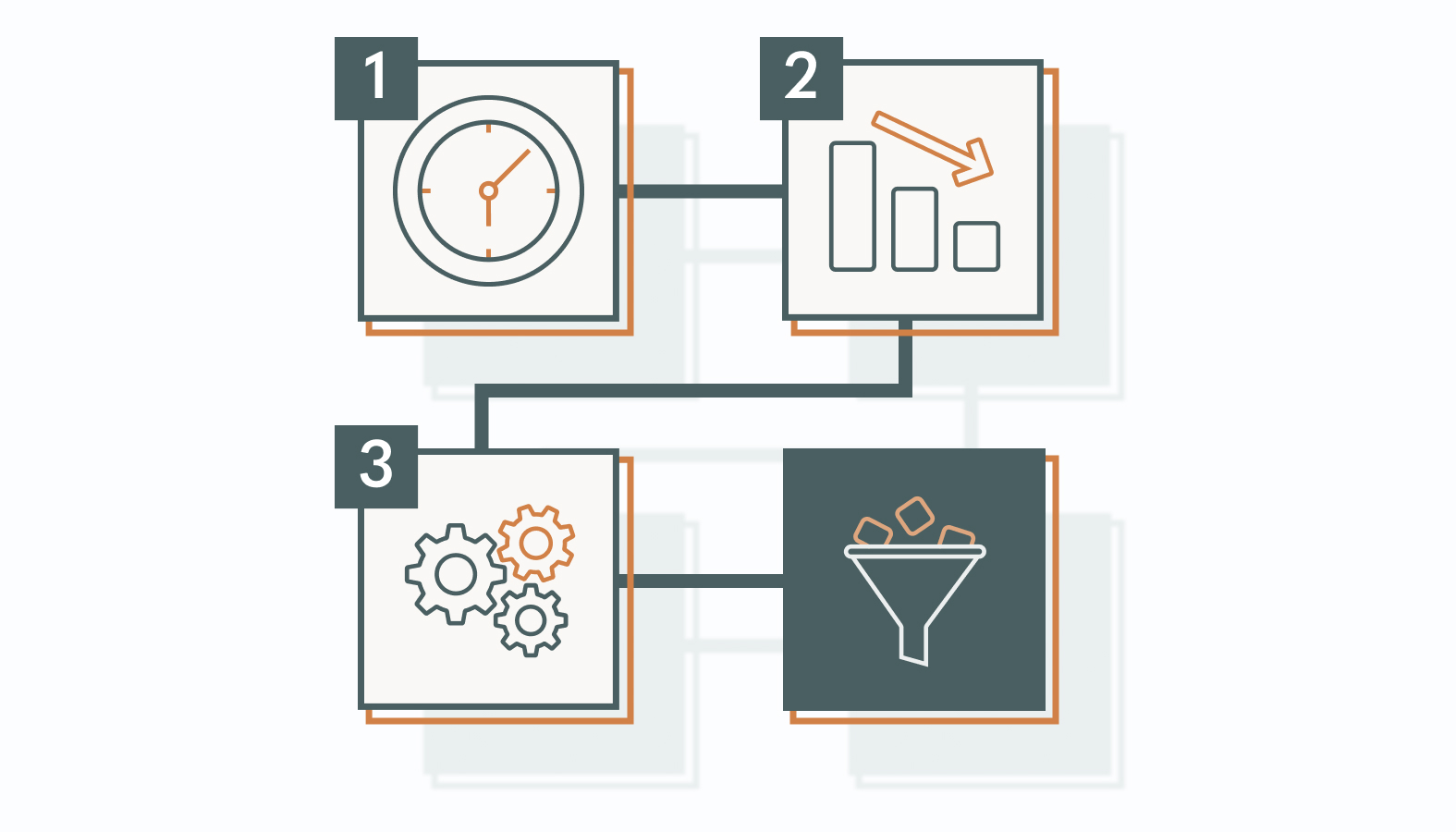
Step 1: Track Pipeline Velocity (Find the Timing)
Measure time-to-conversion at each funnel stage alongside overall pipeline velocity to identify where deals or leads are slowing down. A funnel that looks fine on paper can still be hiding one specific stage where prospects sit idle for weeks before anyone notices. Isolating that exact stage is the difference between guessing at a fix and actually finding one.
Stage-level analysis prevents an acceptable overall average from masking a bottleneck at a specific stage.
Step 2: Analyze Conversion Drops (Find the Volume Loss)
Pinpoint the precise stage where prospects drop off, then figure out whether that drop is a process issue or a product issue.
A steep drop right after a pricing conversation points somewhere different from a drop right after the first demo request. Treating both the same way wastes effort fixing the wrong problem. For example, a post-pricing drop may indicate pricing, packaging, or perceived-value concerns, while a drop after a demo may point to qualification, messaging, or sales-process issues.
Step 3: Audit Tech Integrations (Find the Root Cause)
Map the data flow between your marketing automation platform, CRM, analytics tools, and other revenue systems, then identify the gaps in synchronization, ownership, or data quality. A broken integration doesn’t announce itself. It just quietly stops passing data, and the first sign is usually a report that doesn’t match what a rep is seeing in their actual pipeline.
According to Salesforce’s 2026 State of Sales research, sales leaders estimate 19% of company data is inaccessible, limiting visibility into customer and revenue activity. That inaccessible data often includes deals that are already in motion, which is exactly the kind of mismatch a broken integration produces. By the time someone notices the mismatch, the integration may have been silently broken for weeks.
How to Do Sales and Marketing Alignment
Effective sales and marketing alignment comes down to three practical actions: agreeing on shared KPIs, automating lead handoffs, and establishing clear service-level agreements. If any of the three is missing, the other two become harder to sustain because incentives, processes, and accountability are interconnected.
Aligning Sales and Marketing on Shared KPIs
Establish shared KPIs for pipeline contribution, conversion rates, pipeline velocity, sourced and influenced revenue, and overall revenue performance.
When marketing and sales review the same numbers in the same meeting, disagreements about funnel performance can be resolved more quickly because both teams are working from the same data.
Automating Lead Routing and Handoffs
Manual handoffs become unreliable when someone is on vacation or simply forgets. Automated lead scoring and structured routing remove that dependency, so a qualified lead reaches the right rep within minutes instead of whenever someone checks the queue.
Faster response times can improve lead engagement and reduce avoidable delays in the sales process.
Establishing Clear Service-Level Agreements
Write down exactly who owns a lead at every stage, and exactly how long they have before it needs to move forward.
A service-level agreement is more effective when its ownership, response times, escalation rules, and exceptions are documented. A written SLA gives both teams concrete guidance to refer to when a lead falls through, instead of relying solely on memory.
Building a 90-Day Revenue Operations Framework
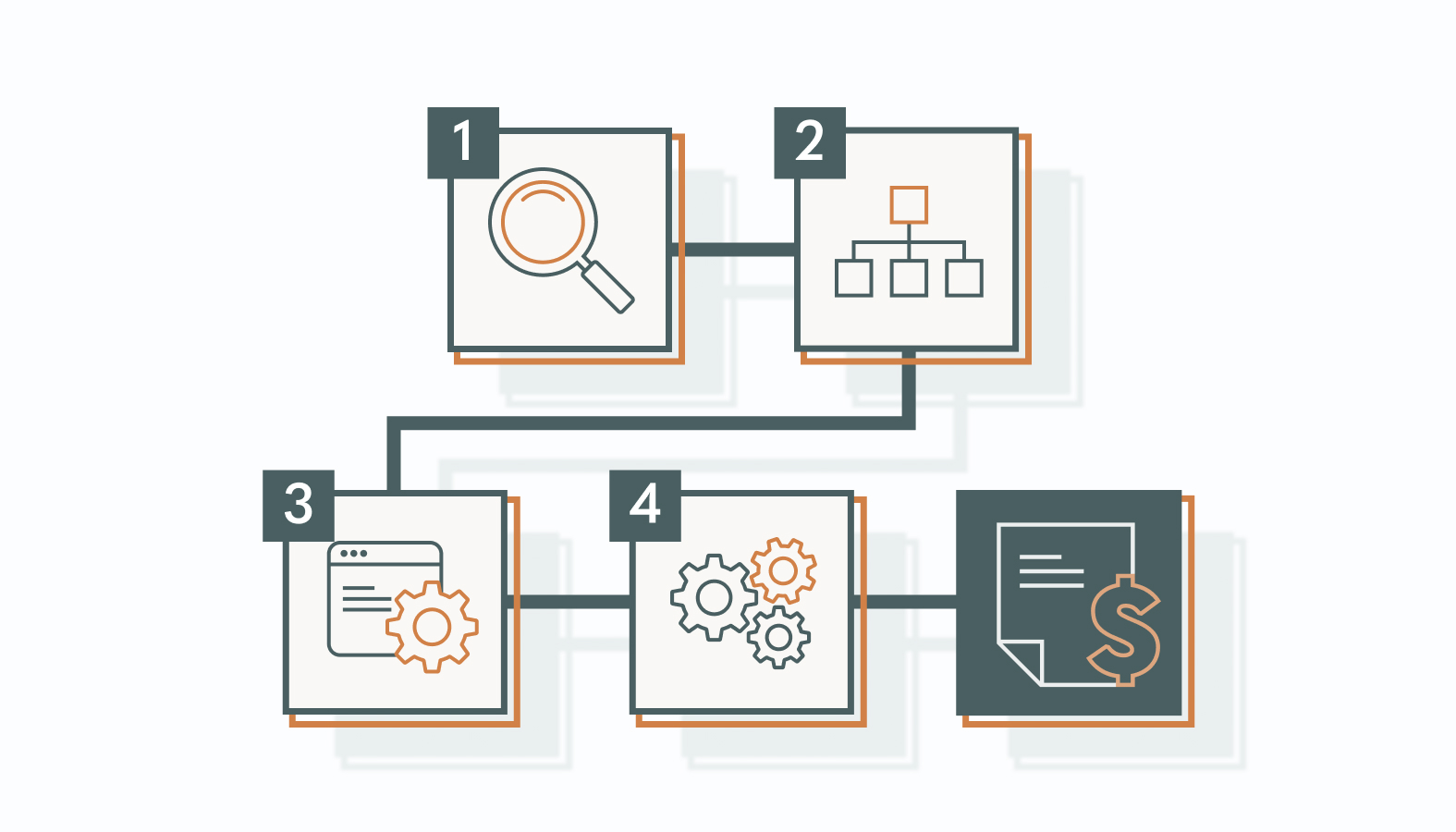
A working revenue operations framework can be implemented across four core phases over roughly ninety days: discovery, redesign, integration, and ongoing optimization. The phases follow a logical sequence, although some activities may overlap.
Step 1: Discovery & Data Collection
Inventory the current technology stack and establish appropriate, role-based access to the systems and historical data required for the audit. Validate the underlying historical data, reporting definitions, attribution rules, and data-governance practices before redesigning the funnel.
This step is often where the biggest surprises show up, since what’s been reported and what actually happened in the data don’t always match. A dashboard built on a flawed underlying dataset will keep producing confident, wrong numbers no matter how good it looks.
Step 2: Funnel Mapping & Process Redesign
Map the customer lifecycle from acquisition through closed revenue, retention, and expansion, then document the workflows, ownership, and handoffs at each stage.
This is the step where the vague, informal processes finally get written down clearly enough that anyone new could follow, without needing separate people to explain the unwritten exceptions.
Step 3: Tool Integration & Automation
Configure the existing technology stack to support the target workflows, while identifying integration or platform gaps that require remediation.
Technology should serve the process. Too many teams do the opposite, letting tool limitations quietly reshape how people actually work until nobody remembers the process was ever supposed to look different.
Step 4: Continuous Optimization
Establish a recurring RevOps governance cadence to review funnel performance, data quality, SLA compliance, technology changes, and emerging bottlenecks.
Real-world performance data should keep adjusting the framework, not just confirm whatever was built in the first ninety days. A framework that stops evolving after launch is already halfway back to being the broken system it replaced.
Real-World Impact: Moving From Bottlenecks to Scaled Growth
A RevOps overhaul shows up directly in the revenue numbers when the underlying data and process problems get fixed, not just documented. The two examples below both started with a real structural bottleneck, not a vague promise that things could be better.
Poolie (Agency Case Study 1)
Poolie’s fast top-of-funnel growth had attracted real private equity interest, but data silos and tracking limitations were holding back their ability to scale sustainably. Nobody could confidently say which channels were driving profitable growth, which made it nearly impossible to plan a serious investment round around numbers everyone trusted.
Agency implemented full data integration across Poolie’s technology stack, connecting its core operations systems with financial data. The integration helped establish more accurate conversion tracking and cleaner dashboard data the leadership team could actually trust when it was time to make a real decision.
The result: Poolie quintupled its baseline business size, growing from $4M to $20M in annual revenue in under a year. The case study also reports a 6.52x LTV:CAC ratio across operational and advertising spend.
Kizen (Agency Case Study 2)
Kizen’s engineering team had built a complex, capable software product, but the company lacked a focused go-to-market and positioning framework. They were marketing to everyone at once, which diluted lead acquisition and stalled enterprise sales entirely, since a message built to appeal broadly to every possible buyer ended up speaking clearly to none of them.
Agency refined Kizen’s Ideal Customer Profile, segmented its enterprise targets, and developed repeatable sales-enablement processes aligned with those accounts.
The result: Kizen progressed from a $1.5M revenue baseline to competing for, and winning, enterprise contracts valued at $20M or more in annual recurring revenue.
FAQs About Revenue Operations (RevOps)
1) What is the difference between RevOps and traditional Sales Operations?
Sales Operations typically focuses on improving sales-team productivity, processes, systems, and reporting, while RevOps coordinates these functions across marketing, sales, and customer success. RevOps treats the entire revenue funnel as one connected system instead of separate departmental concerns. In a nutshell, Sales Operations optimizes sales-team performance, while RevOps coordinates processes, data, systems, and performance across the broader revenue lifecycle.
2) How do I know if my company needs a RevOps framework?
Common indicators include inconsistent pipeline reporting, unclear lead ownership, conflicting definitions of qualified leads, unreliable CAC or attribution data, and recurring friction between revenue teams. A dashboard redesign won’t fix a problem that lives in how the data gets collected, no matter how polished the new dashboard looks.
3) Do we need to completely replace our current tech stack to implement RevOps?
Usually not. Many RevOps challenges can be addressed by improving existing system configuration, integrations, data governance, and workflows before considering a platform replacement. Improving integrations, configuration, data governance, and workflows can often address operational gaps before a full platform replacement becomes necessary.
4) How can I align sales, marketing, and customer success using a RevOps strategy?
Build shared KPIs across all three functions, not just sales and marketing. Customer success data can inform retention, expansion, segmentation, account prioritization, and sales qualification, creating a feedback loop across the customer lifecycle. Without a connected RevOps process, the feedback loop between acquisition, retention, and expansion can remain fragmented.
5) What key performance indicators should a RevOps team track for optimal performance?
Core RevOps KPIs can include pipeline velocity, stage-level conversion rates, sales-cycle length, CAC, LTV:CAC, sourced and influenced revenue, win rate, and retention or expansion metrics. Each of those ties directly to revenue, while lead count alone doesn’t determine whether that revenue is actually coming. A team can hit every lead volume target on the board and still be losing money on every deal that closes.
6) How long does it take to see measurable ROI from a RevOps strategy?
Most teams see early signals, cleaner data, and faster handoffs within the first ninety days. Full revenue impact reflected in a quarterly report usually takes two to three quarters to show clearly, since it depends on deals that were already working through the newly fixed funnel. The earliest wins are usually operational. The revenue wins follow a couple of quarters behind them.
Turn Your Leaky Funnel Into a Scalable Revenue Engine
RevOps isn’t about chasing another unfulfilled marketing promise. It’s about capital efficiency and results you can trace back to a specific fix, not a vague promise of organization. Every leak covered here, such as siloed teams, inconsistent data, and broken handoffs, costs real revenue every quarter it goes unaddressed. That cost compounds the longer it sits unfixed, quietly widening the gap between what marketing reports and what sales closes.
Stop guessing where your pipeline is broken. Schedule a candid conversation with an Agency Sales Enablement and RevOps expert for a data-driven review of your current funnel.