


Integrated content marketing happens when your blog, email, social media, and paid campaigns carry the same underlying message, tailored to each format, aimed at the same buyer, and timed to work together. Some companies are not doing this. They are running parallel tracks that look active from the inside but send conflicting signals to the people they are trying to reach.
This article gives you an operational definition you can use right now, a cross-channel execution framework built for 2027, and a way to measure whether the integration itself is producing results, not just whether individual assets are hitting their own benchmarks.
What Is Integrated Content Marketing?
Integrated content marketing connects your channels around one core message, adapted to each platform and audience. You’ll want your buyer to hear the same message whether they are reading your blog, opening your email, or clicking on your paid ad.
Think of how a movie is marketed: the trailer, poster, and film each serve a different purpose while communicating the same core story. That is how you should approach your content. Have one main idea and adapt it for each channel you use to reach your buyers.
This approach can also help reduce unnecessary production costs. Instead of developing unrelated content for every channel, your team can build multiple assets around one core idea. That reduces duplicated effort while giving buyers a more consistent understanding of your message. With effective execution and measurement, it may also improve campaign efficiency and customer acquisition costs.
Why “Aligning Your Channels” Is Not Enough for True Integrated Content Marketing
Some marketing teams assume that publishing a blog post, sharing it on social media, and including it in a monthly newsletter automatically creates an integrated content marketing strategy. While these steps help distribute content, they don’t necessarily connect the channels into one coordinated campaign.
Your content should not only be distributed across your various channels. It should also be tailored to that specific channel. Not everyone who sees your content on social media will read your blog post. But when your social content delivers the message in a format suited to that audience, it has a better chance of generating engagement or encouraging the next action.
An integrated content marketing strategy carries one core message across blog posts, social media, email, and paid ads, while adapting the format and supporting details to each channel.
While strategic content marketing management establishes the workflows and processes behind content production, integration focuses on how individual channels support one another within a campaign.
The 2027 Framework for Cross-Channel Integrated Marketing Strategies
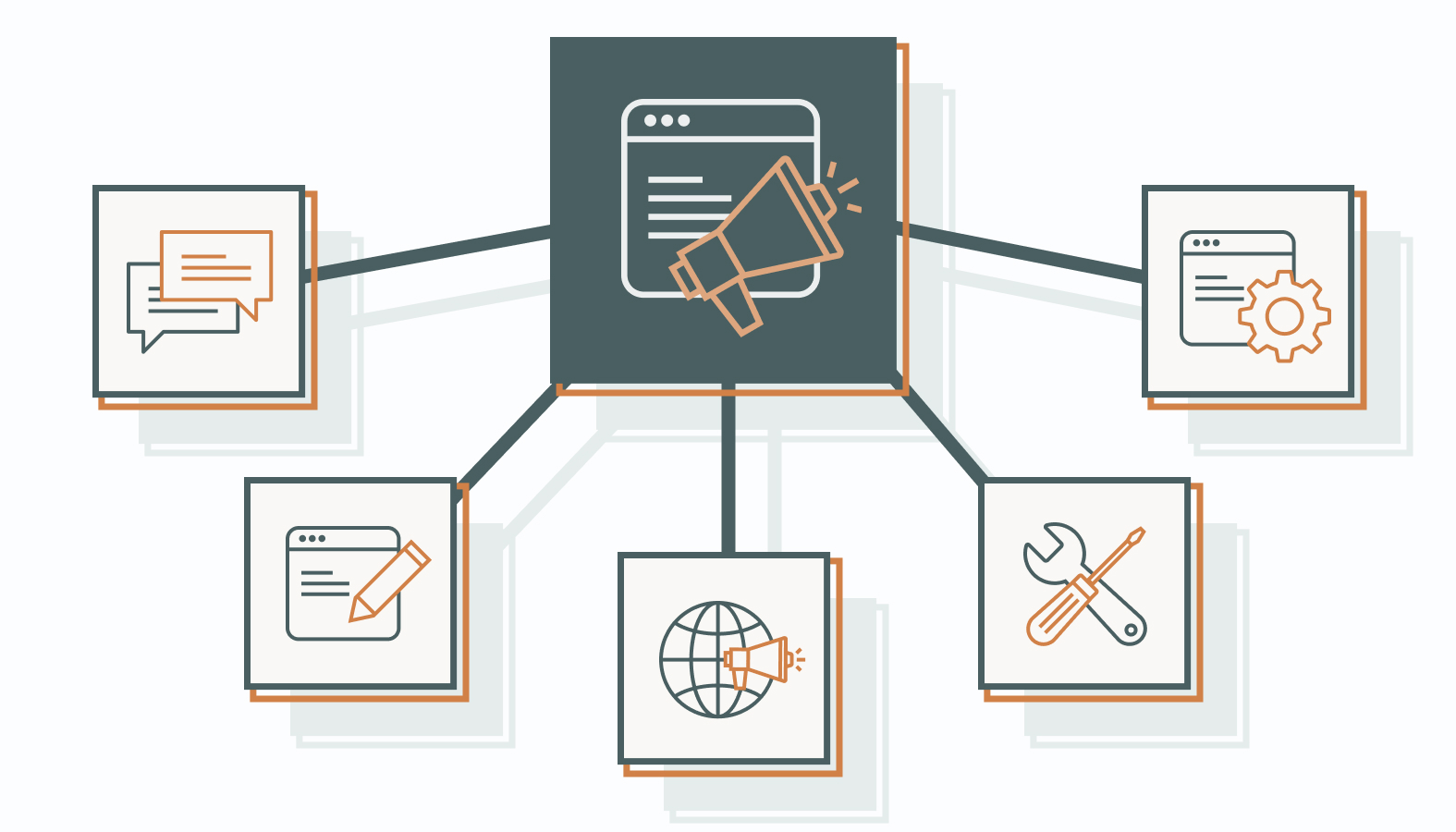
Most integrated marketing strategies fail in execution because they start at the channel level. Teams build a social calendar, then figure out how to connect it to the blog, then wonder why the email list is not engaging. This framework reverses that sequence. It starts with one anchor asset and builds outward, so every channel output has a clear origin, a consistent message, and a defined role in the buyer’s journey.
Once you’ve aligned your content strategy with business goals, the next step is connecting the assets and channels needed to execute the campaign.
Step 1: Build a Core Asset Around One Campaign Message
Start with one core idea or message that you want to carry across all your content marketing channels. Anchor it in a substantial asset, such as a blog post, original research study, case study, or other long-form resource. When selecting your topic, avoid anything too broad or general. Generic best-practice topics are often covered by many companies, making it harder for your content to stand out. Make sure you have data or information that you can provide to your audience. This gives you a stronger message to carry across channels and provides your sales team with useful material to support buyer conversations.
Having one core asset can reduce the time your team spends deciding what content to create each week. Each channel can take this and create content based on that topic for their channel, so you optimize your integrated content marketing strategy and keep your team aligned.
Step 2: Connect SEO, Email, Social, and Paid Campaigns
Now that you’ve created your core macro asset, it’s time to create smaller pieces that feed off of that asset. If you created a long-form blog post, several topics within it might deserve their own articles. Each supporting article can target a distinct search intent while linking back to the core asset where relevant. This creates a connected content structure that helps buyers explore related topics and gives search engines a clearer understanding of how your content fits together.
You can adapt those same topics into social media content. For example, turn the key takeaways from your study into a LinkedIn carousel or create a thread on X that highlights one finding and encourages readers to explore the full research. Each asset should deliver value on its own while reinforcing the campaign’s central message.
Paid advertising can extend the reach of your core campaign, whether you launch ads alongside the original asset or use insights from organic engagement to refine the messaging. Test different angles based on audience needs, then direct buyers to a landing page or resource that continues the same message. This helps create a consistent experience from the ad to the next stage of the buyer’s journey.
For example, a B2B company could build a campaign around a research report showing how disconnected marketing systems increase acquisition costs. The report becomes the core asset, with each channel supporting a different part of the buyer’s journey.
The SEO team creates a supporting article explaining the operational costs of disconnected systems. Social media highlights a compelling finding from the report to start conversations with potential buyers. An email sequence shares the research with existing prospects, followed by a case study showing how another business addressed the problem.
Meanwhile, paid campaigns promote relevant findings to target accounts and direct them to the full report or a related landing page. The sales team uses the same research and case study in conversations with prospects concerned about acquisition costs.
All these assets carry the same underlying message, but each serves a specific purpose. A shared campaign timeline keeps the content coordinated, so buyers encounter consistent information as they move between channels.
Step 3: Connect Campaign Content to Sales Enablement
The last step in the framework is to connect the content back to the sales team. At this stage, you have a macro-asset, a cluster of SEO pages, a set of social and email outputs, and paid creative that reflects what the audience actually engages with. All of that is also sales material, and the reps working active pipeline rarely know it exists. The LinkedIn B2B Institute reports that the average B2B buyer consumes 13 pieces of content before considering a conversation with sales. That makes coordination between marketing content and sales conversations especially important.
Sales enablement in an integrated framework means surfacing the right content variation for the right objection. The prospect who pushed back on implementation complexity needs the case study that addresses exactly that. The VP who questioned ROI needs the data breakdown from the macro-asset reformatted as a one-page summary she can share with her CFO. These are not new assets. They are the downstream outputs of the macro-asset, repurposed one more time for a specific use in an active deal.
How to Measure Whether Your Integrated Marketing Strategies Are Actually Working
Start by tracking content-influenced pipeline, pipeline velocity, and sales cycle length. These metrics help you understand whether your connected content is supporting opportunities and helping buyers move through the sales process. ABMatic explains that most B2B deals involve multiple touchpoints rather than a single source. Multi-touch attribution can help teams understand how different channels and content assets contribute to opportunities, rather than relying solely on the last click.
Where your analytics and CRM data allow it, use multi-touch attribution to understand how different content assets contribute to the buyer journey. Review those findings alongside pipeline metrics rather than relying on last-click conversions alone.
Message consistency matters, too. Review whether your blog, email, social media, and paid campaigns reinforce the same core argument. If one channel promotes a different promise or offer, buyers may encounter a disconnected experience even when the individual assets perform well.
You can also track how buyers move between campaign assets, such as from a paid ad to a landing page, from an email to a case study, or from a content download to a sales conversation. These connections help reveal where the campaign supports progression and where the buyer journey breaks down.
How to Scale Integrated Content Production Without Losing Consistency
When your channels grow, your next move is to find ways to keep your messaging consistent without spending too much time creating piece-by-piece content for each channel.
The practical version of this looks like a production brief that travels with every downstream asset. The brief specifies the core argument from the macro-asset, the specific angle relevant to this channel’s audience, and the format requirements for that platform. Every person producing a downstream output (a social post, an email, a paid ad) works from the same brief. That brief is the operational mechanism that keeps the integration intact as the team scales.
Use tools to support tasks such as resizing images, drafting copy, and scheduling posts. However, those tools still need clear direction and human review to ensure every asset reflects the campaign’s central message. Without that oversight, teams risk producing more content without maintaining consistency.
Where AI Can Create Cross-Channel Inconsistencies
One risk of using AI tools in SEO and content marketing integration is producing content without a central editorial brief. Without clear direction, the output may rely on generic phrasing or introduce inconsistencies in brand voice across channels.
The fix is not to stop using tools. It is to anchor every tool-assisted output to a human-defined core narrative before production starts. The brief comes first. The tool executes against the brief. A human reviews the output against the brief before it goes out. That sequence keeps the integration intact regardless of how many channels or formats are in play.
Another important input is original source material. Proprietary client data, results from real engagements, and insights developed through years of experience give your cross-channel content more credibility and differentiation. AI tools can help organize and adapt that information, but they should not replace the original research and expertise behind it. The teams that maintain search authority and brand consistency over time are the ones that invest in building original source material first, and use tools to distribute it efficiently after.
Agency’s Integrated Content Marketing Services and What They Include
Agency brings fractional marketing talent to companies that need integrated content marketing execution without the overhead of building a full-time team. Its flexible model allows businesses to scale marketing support based on their needs. When a campaign requires intensive cross-channel coordination, the engagement scales up. When execution needs less support, resources can be scaled back. This gives businesses more flexibility as campaign requirements change.
Agency’s international talent network supports the functions this framework requires, including content strategy, SEO, paid media, sales enablement, and editorial execution. Each function gets managed by a person who works in that specific field, coordinating with a lead strategist who holds the integration together.
It’s not about handing you a strategy document and leaving. It’s about being in the execution long enough to catch gaps before they compound. This can include developing high-quality core assets around your campaign plan, supporting multi-touch attribution, and conducting messaging reviews to keep content consistent across channels.
Frequently Asked Questions
How long does it typically take to see measurable results from an integrated content marketing strategy?
It depends on your current domain authority. If you already have a good amount of organic traffic, you can start seeing results in 6-8 weeks. If you are starting from scratch, you will want to give it at least 3-6 months to see results.
Are integrated marketing strategies effective for small businesses with limited budgets?
Yes. Integrated marketing strategies are not just for the big companies with large budgets. In fact, having an integrated content marketing strategy can benefit small businesses more, because you’re creating less content that spreads your message to more of your buyers.
What are the biggest operational risks of running an integrated campaign without a dedicated strategy?
The first would be that you’ll be spending more money on content that isn’t creating ROI. Another would be that your team is burned out from creating content for each channel. And the last is that you can be sending mixed messages that create confusion for your buyers.
How does deep SEO and content marketing integration change the way we plan seasonal campaigns?
By using SEO and content marketing integration, you’ll be able to create evergreen content that will continue to drive traffic to your website, instead of creating content that is meant to rank for just a month and then disappear. You can update that content to continue to drive traffic and increase your rankings on Google.
Lock In Your Integrated Strategy for 2027
When your blog, email, and social media content are optimized for separate metrics and managed without coordination, you risk duplicated production effort, inconsistent messaging, and a disconnected buyer experience. That’s the structural cost of disconnected content, and it’s a problem worth addressing before your next planning cycle.
Running separate channel calendars into 2027 without a shared campaign plan can create unnecessary production costs and missed opportunities. Companies that connect their content around one core message, adapt it for each channel, and measure how those channels work together are better positioned to improve campaign efficiency and support pipeline growth.
Schedule a candid conversation with one of our experts. Bring your current channel setup, content gaps, and an honest assessment of whether your channels are working together or in parallel. Let’s map out where better integration could reduce duplicated effort and improve your campaign performance.