


A marketing budget outlines how much your business plans to spend on marketing over a specific period and where that money will go. Some companies start with last year’s budget or an industry benchmark.
But without considering your revenue target, customer value, and acquisition costs, that budget can become little more than a spending limit. You need to understand what the planned investment can realistically deliver.
This guide shows you how to build a marketing budget backward from business outcomes and what leadership should check before approving it.
The Flaw in Traditional Budgeting: Why Benchmarks Aren’t Enough
Industry benchmarks show what other businesses spend, but they don’t tell you what your business needs to invest. Use them as a reference point, then account for your margins, sales cycle, target customers, and growth goals.
In the 2026 CMO Survey, respondents reported marketing spending averaging 9.0% of company revenue overall, compared with 12.0% for B2C product companies and 7.0% for B2B product companies. Copying last year’s budget without reviewing performance creates a similar problem: it carries old assumptions into a new planning period.
The Danger of the Copy-Paste Budget
Likewise, building your budget by copying your competitor’s channel mix is going to lead to average results. They might have different unit economics (e.g., bigger deal sizes), a longer customer lifespan, or investors who allow them to spend big bucks to make a loss because they’ll be making it up down the track.
You need to consider your unit economics, which are how much revenue each customer generates, how much you can afford to spend to acquire them, and how long it takes you to make that spend back.
Marketing Spend vs. Marketing Investment
Instead of asking only, “How much can we afford to spend?” also ask, “What return do we need, and what investment could support it?”
For each budget line, define its purpose, expected contribution, success metric, and review period. That gives you a basis for increasing, reducing, or maintaining spend.
Building Backward: The Step-by-Step Budget Construction Framework
Follow these five steps to turn your revenue goal into a working budget. Start with the targets and acquisition economics, then account for committed costs before allocating money to channels and contingency.
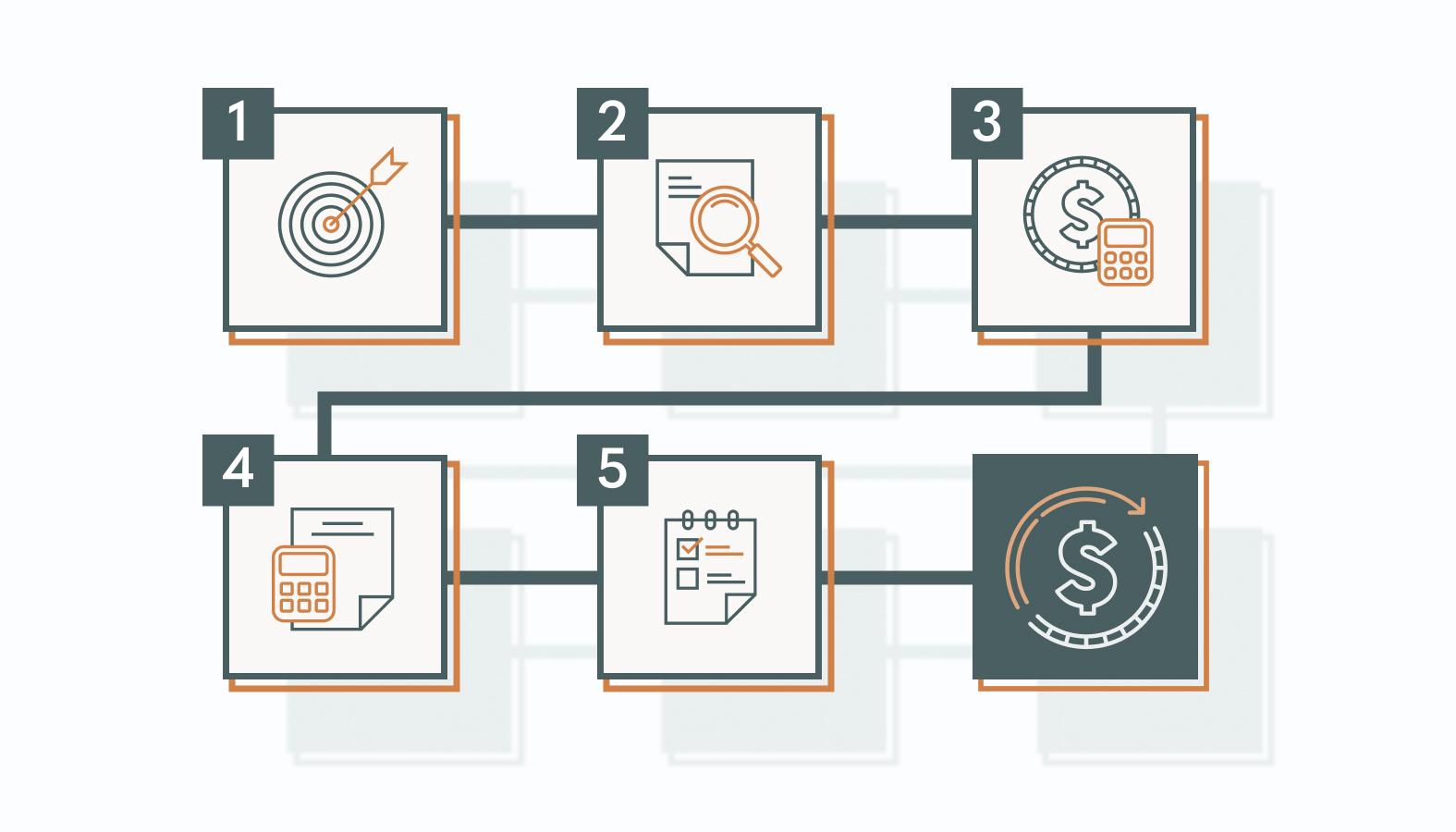
Step 1: Map Your North Star Growth Targets
Start with the new-customer revenue target for the planning period. For example, a $2 million target requires 50 deals if each contributes $40,000 in revenue during that period. At a 25% opportunity-to-customer close rate, you would need 200 qualified opportunities. Agree with sales on how many marketing must generate and allow for the time those opportunities take to close.
Use historical deal values and close rates from comparable customers and channels. If you expect performance to improve, document what will drive that improvement rather than building it into the forecast without evidence.
Step 2: Audit Customer Economics & Unit Margins
Set a customer acquisition cost (CAC) ceiling using customer lifetime value (LTV), gross margin, and available cash. For this calculation, use LTV based on expected lifetime gross profit so delivery costs aren’t overlooked. If that value is $90,000 and your business selects a 3:1 LTV-to-CAC target, the implied CAC ceiling is $30,000. Treat that ratio as a planning assumption, not a universal standard. Include both sales and marketing acquisition costs in CAC.
Also check the CAC payback period: how long it takes a customer’s gross profit to recover the acquisition cost. All else equal, a six-month payback puts less strain on cash flow than a 24-month payback.
Step 3: Estimate Required Spend and Account for Committed Costs
Estimate the cost of generating marketing’s share of the required opportunities using historical costs from comparable campaigns. For example, if marketing must generate 120 qualified opportunities at an estimated media cost of $1,500 each, the initial media estimate is $180,000. Add production, staffing, tools, and external support costs that the estimate does not already include.
Separate committed costs, such as salaries, retainers, and software subscriptions, from adjustable campaign spending. Check the total against your acquisition-cost ceiling and available cash. Avoid counting the same cost twice.
Step 4: Allocate Your Budget Across Four Priorities
One practical way to organize adjustable spending is to group it into four priorities:
- Performance: Acquisition channels, such as paid search, with pipeline and revenue expectations matched to your sales cycle.
- Compounding: SEO and content marketing that can build visibility and demand over time.
- Optimization: Conversion rate optimization, user experience testing, and analytics that help identify and improve weak points in the customer journey.
- Experimentation: Tests of new channels or creative formats, each with a defined spending limit and learning objective.
The split should reflect your goals, evidence, and time horizon. If you need qualified pipeline quickly, proven acquisition channels may take priority. If you can invest over a longer period, allocate more to content and SEO. Assign each expense once, even when it supports several priorities.
Step 5: Scenario Planning & Risk Margins
Set aside a contingency reserve based on cost volatility, contractual commitments, and available cash. If you choose a 10–15% reserve, treat it as a planning assumption and explain why it fits your business.
Prepare base, reduced, and expanded versions of the budget. Decide in advance which commitments you must protect, which activities you can pause, and what evidence would justify additional spending. Preserve the measurement needed to evaluate the remaining investment.
The Executive Sign-Off: 5 “Before You Approve” Questions
Leadership should be able to answer five questions before approving a marketing budget. If any answer is missing, the budget isn’t ready.

Question 1: What assumptions connect this allocation to our growth target?
Each allocation needs a clear business case. For example, $120,000 in paid search at an estimated $1,500 per qualified opportunity would generate 80 opportunities. At a 25% close rate and $40,000 in revenue per deal, that would represent $800,000 in revenue, assuming those deals close and the revenue falls within the planning period.
Document where those assumptions come from. For investments such as brand development or analytics, define their expected contribution and evaluation method rather than forcing a direct revenue forecast.
Question 2: Can we measure whether this allocation meets our return target?
Set a return target that reflects your margins, full costs, and expected payback period. Track meaningful conversion actions and, where relevant, connect lead records to opportunities and closed revenue in your CRM.
Agree on how performance will be evaluated, when results should appear, and what the data cannot reliably attribute. If evidence is limited, approve a capped test with clear learning goals rather than treating the forecast as proven.
Question 3: Is our creative production budget scaled to survive rapid ad fatigue?
Ads become less effective over time with repeated exposure to the same audience. A budget that funds media but not new creative will see click-through rates fall and costs rise within weeks.
For example, a team that runs three months of LinkedIn ads with one set of images often pays more per lead in month three than in month one. Fund regular creative refreshes from the start.
Question 4: What is our exact “kill switch” metric for underperforming testing channels?
A “kill switch” is a predefined rule for pausing or ending a test. For example, cap spending at $15,000 and review performance after 60 days, allowing for the normal conversion delay. If there is enough evidence to judge the test and cost per qualified opportunity remains above $3,000, pause it. If the spending cap is reached sooner, stop additional spending and review the available results before approving more.
Question 5: Are external leadership and execution fees factored directly into this layer’s ROI calculation?
Agency, consultant, and fractional leadership fees are part of the cost of every result. A channel that returns $30,000 on $10,000 in media looks like a 3-to-1 return. Add a $5,000 monthly management fee, and the true return is 2-to-1.
Leaving fees out makes weak channels look profitable. Count internal salaries the same way when a channel depends on a dedicated hire.
Frequently Asked Questions
Should I match the average marketing budget for my industry?
No. Industry averages are calculated across businesses with varying profit margins and retention and growth rates. Setting your own company’s rates to match an industry average won’t help you because these rates won’t be based on your company’s economics.
Use benchmarks to screen candidates, then develop a business plan based on revenue goals and CAC limits.
How do escalating ad costs impact our channel minimum budgets?
As cost per click and cost per thousand increases, the required minimum spend for testing a channel increases. Ad platforms must generate a certain number of conversions to optimize performance. For example, Google Ads Help recommends at least 30 conversions per month, per ad group, for Display campaigns that use Smart Bidding to hit its target consistently. It also notes that ROI and performance are hard to measure with low conversion volume.
If your spend is too low to produce that data, results stay inconsistent, and you can’t tell whether the channel works. Fund fewer channels fully instead of many channels thinly.
When does it make financial sense to hire budgeting consultants?
It makes sense to hire budgeting consultants when growth has stalled, and you need data, not estimates, to justify the next level of spending. The fee is small compared with a year of misallocated budget.
Agency’s fractional CMOs build the tracking, unit economics, and allocation model with your team, so every amount in the plan has a reason behind it.
Stop Guessing, Start Allocating
A healthy marketing budget connects growth targets to acquisition economics, committed costs, and clear spending priorities. Before approving it, check the assumptions, measurement plan, and conditions for changing course.
The exercise may show that you need more investment, a different allocation, or a more realistic target. What matters is knowing why each amount is in the plan.
If you want experienced marketing leaders to review your plan before you sign it, schedule a candid conversation with one of our experts. Bring your draft budget and your growth target. We’ll show you which lines are supported by data and which ones need more work.