



For Funds & Operating Partners

“How Do You Know?” Deserves a Precise Answer, Not Adjectives.

Tracy Burzycki of Apollo calls it her favorite question to ask companies. She was talking about customer and pricing insight, but you already know what happens when the question lands on growth: a dashboard, a deck, or “trust me.”

Several years into a longer hold, “trust me” stops working.

We install and run the complete growth function inside portfolio companies, and close the commercial numbers monthly to a standard your deal team would recognize. Definitions the CFO signs, CAC reconciled to the general ledger, and attribution that admits what it doesn’t know.

Operating partner reviewing portfolio company growth data on a laptop

$4M → $20M

in the first 12 months

Operating inside portcos across multiple PE funds

Organic traffic +225% in under 8 months

The Same Function, Wherever It’s Needed.

Most founder-led acquisitions have the same gap: real product, real revenue, no real growth function. Someone’s cousin runs the ads. The CRM is a suggestion. Nobody owns pipeline.

Your industry has already decided where the return lives.

  • 72% of GPs rank operational improvements their top lever

  • 71% prioritize operations over financial engineering

  • 59% say value creation is most impactful for exit readiness

  • 55% call value creation the most challenging

Sources: S&P Global Market Intelligence 2026 PE Survey (72%, 71%); EY Global PE Exit Readiness Study 2026 (59%, 55%).

You can help each management team hire, vet and manage their way out of it, one company and eighteen months at a time. Or you can deploy the same function wherever it’s needed.

The same function. Strategy, execution and management across every channel that matters, installed inside the company rather than bolted alongside it.

The same close. Every company running the monthly Commercial Close, on definitions its own CFO signed.

The same construction. A growth slide from one portfolio company tells you how the growth slide at the next one was built.

Management gets a function they couldn’t otherwise staff. Their numbers stop being something you have to take on faith.

Hands on a laptop showing a portfolio company KPI dashboard

What You’ll Vet Us On.

A portfolio company CEO asks whether we can fill a gap. You ask whether one firm works across eight companies without being rebuilt each time. Different question, so here are the answers.

We’ve Been Through This Evaluation Before

One fund has now sent us three of its portfolio companies. A partner there sourced and vetted us, recommended us to the first CEO, and made the introduction for that CEO’s sign-off. After it worked, the operating partner did it again at a second company, and the fund’s co-founder at a third. Same sequence each time, which is the sequence this page is describing.

Repeatability

The KPI dictionary, the data request list, the reconciliation bridge and the board page are standard artifacts. Company-specific judgment goes into inclusions and exclusions, not into method. The second engagement starts from the first one’s templates.

Governance

Definitions are signed by each company’s CFO and versioned. Changes are logged, dated and approved on their side. Nothing gets restated silently in any company, including at our initiative.

Security and Access

Read-only and extract-based. We never hold write access to a system of record. We hold no security certification and won’t imply one. The access model is the answer, and we’ll walk your operations team through it.

Exit Readiness

Twenty-four months of signed definitions and logged restatements is what a commercial data room looks like when it holds up. It stays with the company whether or not we do.

Does This Land on Your Desk?

No. We build, reconcile and close; the company’s CFO reviews and signs. You get a document you didn’t have to assemble.

What an Introduction Is Worth.

A marketing due diligence review is priced at $7,500. We waive it for portfolio companies introduced by their funds.

That isn’t a discount and it isn’t a favor to us. It’s your relationship capital, spent on the CEO’s behalf, with a number attached. We’re reciprocating accordingly for the opportunity you’re providing us.

Two weeks. Read-only access to their platforms, if possible. Findings on what’s working, what isn’t, and what each gap is costing. We take about two waived reviews a month, because they compete with paid delivery for the same analyst hours.
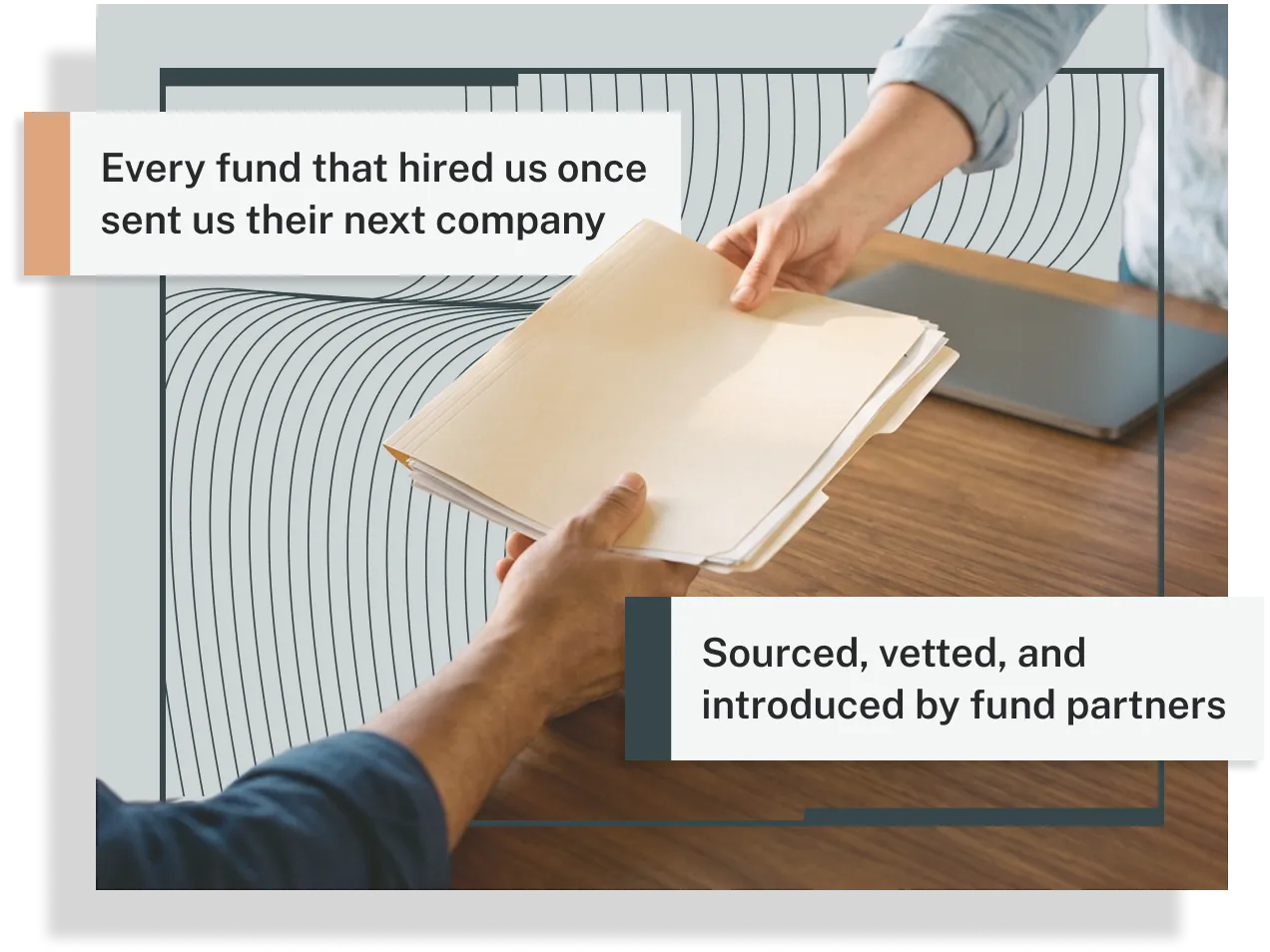
Fund partner handing over a folder – every fund that hired us once sent us their next company

Why It Lands With the CEO as Backing, Not Checking.

You know the failure mode. The fund suggests a vendor, the CEO hears an audit, and every number afterward arrives pre-lawyered.

So this was built the other way around.

The villain is a control gap, never a team. Marketing didn’t fail. Nobody ever gave the company a way to close its commercial numbers. That’s the story because it’s true, and because a CEO can accept it without swallowing anything.

“You’d be amazed by the number of CEOs who don’t ask for our work on the deal. It would be the first thing I would ask for.”

— John Connaughton,

Co-Managing Partner, Bain Capital

Strong CEOs Use What the Fund Makes Available.

Some of them need to be told it’s available. Once they are, nobody in the company should feel like they’re being audited. Marketing, the CFO and the CEO each come away with something they didn’t have before.

Marketing Keeps Running Growth, Believed for Once.

Most marketing teams have never had a CFO sign off on their numbers. It changes how the company treats them.

The CFO Gets Sign-Off Authority, Not Homework.

Their name on the definitions is what makes the figures institutional, and it costs them about two hours a month.

The CEO Gets a Board Pack They Can Defend Without Flinching.

That’s the whole pitch. Your visibility is a consequence of their credibility, never the other way around.

Tell Us Where You Are Today. We’ll Come Back With What We’d Look at First.

Four questions to start. We’ll model the opportunity against your financials, audit the channels and systems you’re running, and deliver the findings – yours to keep regardless of what comes next.

"*" indicates required fields

This field is for validation purposes and should be left unchanged.
What growth functions is your organization currently most interested in? (Check all that apply)
Portfolio company CEO smiling while reviewing growth numbers on a tablet

When To Refer One of Your Portcos.

Just Closed

Definitions set right from the start cost less than restating them in year four, and nobody’s defending prior work yet.

A Growth Line You Don’t Believe

The plan has an organic number, the company reports activity, and the two have never been reconciled.

A Platform With Acquired Entities

Five add-ons arrive with five CRMs, five definitions of a customer and five brand surfaces competing in search. There’s no single defensible growth number in that structure.

Twelve to Twenty-Four Months From a Process

Late enough that exit is real, early enough that a restated series that will survive the data room has time to get established.

If none of the above accurately describe where your portco is at, we’re probably not the team you need at this stage, and we’d rather say so than waste your introduction.

For Deal Teams: De-Risk Before You Buy.

Everything above serves companies you already hold. This is for the ones you’re still deciding on.

Buy-side on a target or sell-side ahead of your own process: we run marketing and commercial diligence as a paid engagement, quoted per deal. Your budget, your timeline, workpapers your team keeps.

You’ve bought quality-of-earnings. This is the same discipline aimed at the commercial engine: CAC as actually loaded, churn as actually cohorted, pipeline as it actually converts, attribution stress-tested against the claims in the CIM.

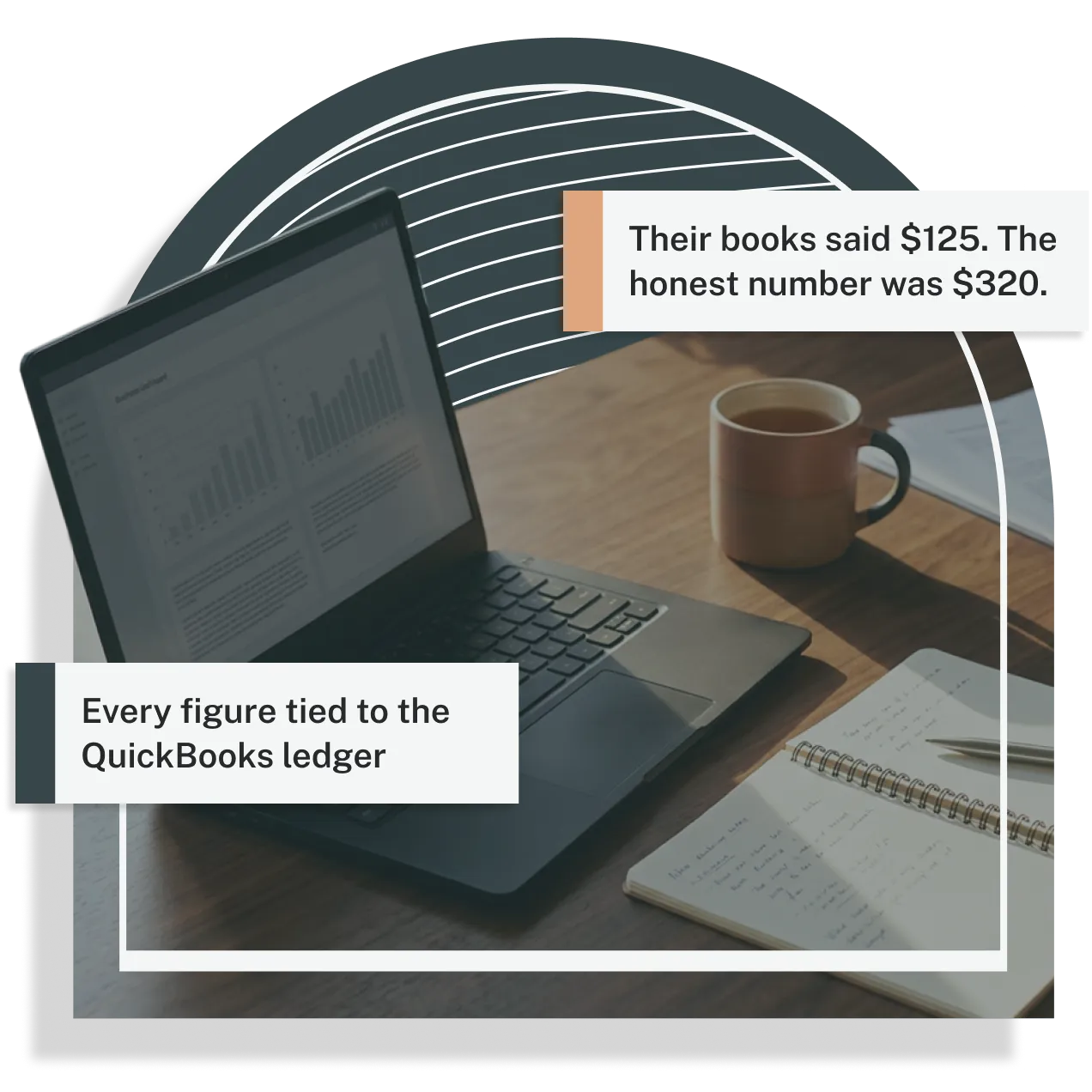
Laptop with callouts: their books said $125, the honest number was $320, every figure tied to the QuickBooks ledger
Woman working on a laptop outdoors, reviewing marketing diligence before a deal

Start With One, and Keep the Downside Small.

The reason to try this on a single company is that the introduction is the only thing you’re spending, and you can see what came of it before you spend another.

Send us the one company where the growth story matters most and the evidence is thinnest. We never shy away from a good challenge.