The marketing mistakes that hurt B2B companies most in Q4 are often not major failures. They’re small, predictable gaps that go unaddressed until tighter deadlines and higher revenue pressure expose them.Strategies built around short consumer buying cycles don’t always translate to B2B, where multiple stakeholders, longer sales cycles, and more complex buying decisions can extend the path from first touch to closed revenue.
Many Q4 execution problems trace back to planning gaps that could have been identified before the quarter began. This guide covers 10 marketing mistakes to avoid before Q4, and the planning steps that can help B2B teams address them before they affect pipeline and revenue.
10 Marketing Mistakes to Avoid in Your B2B Strategy
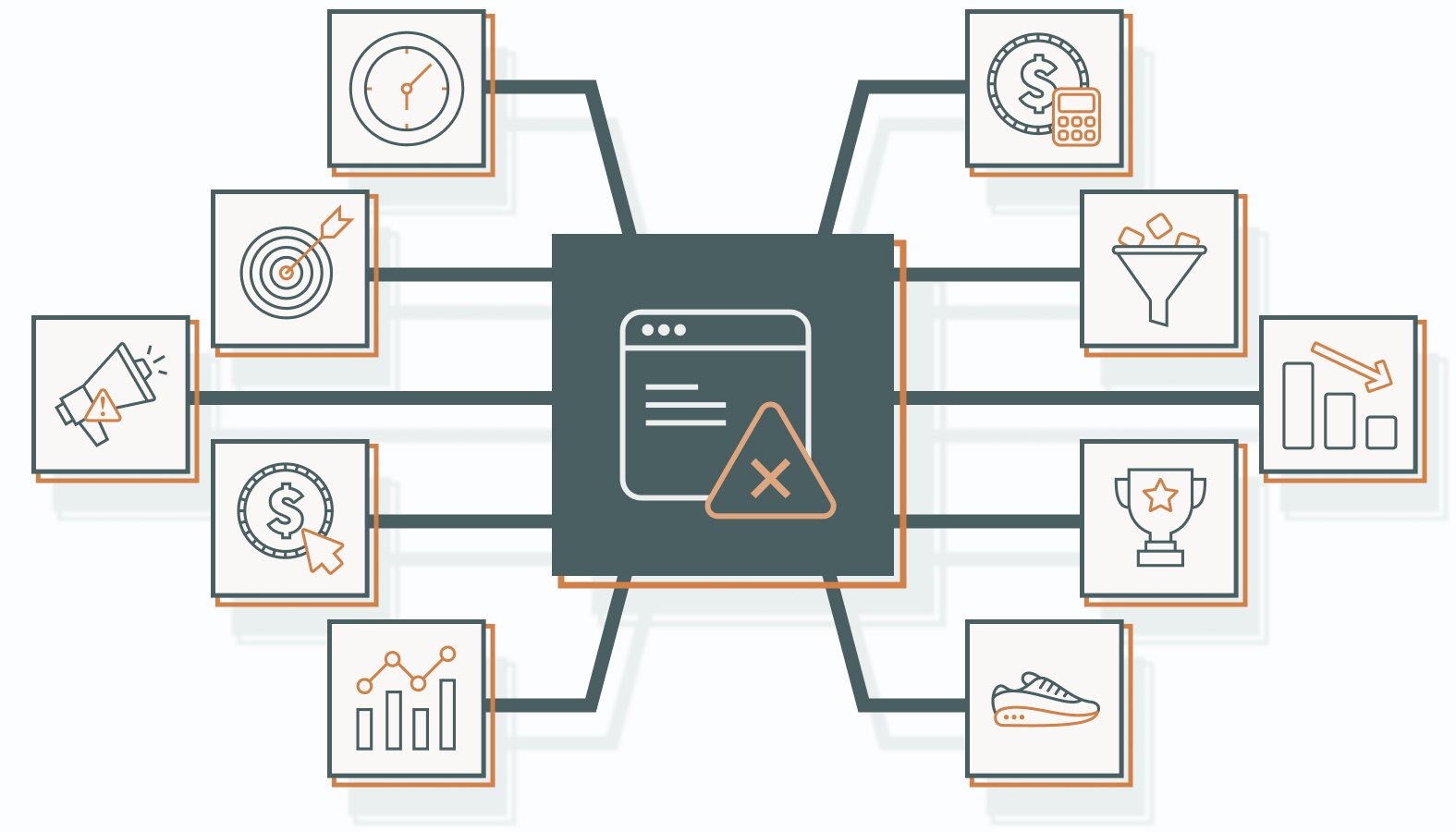
These 10 mistakes represent common, avoidable ways B2B teams can put Q4 pipeline and revenue at risk. Most stem from planning gaps rather than a lack of effort, and the cost of addressing them generally increases once Q4 is already underway.
1. Waiting Too Long to Build a Quarterly Marketing Plan
Waiting too long to plan can leave a B2B team behind before Q4 even begins. Because many B2B sales cycles extend beyond a single quarter, campaign timing needs to account for the time required to generate, qualify, nurture, and close demand.
Optifai’s 2026 pipeline study, based on stage-level CRM data from 939 B2B SaaS companies, reports sales cycles ranging from roughly 90 to 180+ days for larger deals. For a deal with a 90-day sales cycle, waiting until October to generate demand leaves limited time for qualification, evaluation, negotiation, and closing before year-end. Launching late can also put teams at a disadvantage in paid media, as Q4 competition can increase demand for advertising inventory and make efficient budget allocation more difficult. A delayed launch can also leave teams competing for media inventory after Q4 demand has already intensified.
2. Falling into the Trap of Broad, Unfocused Targeting
Broad targeting can divert Q4 budget toward audiences that are less likely to become qualified opportunities. Casting a wide net feels productive right up until the results come in.
Use historical performance and first-party CRM data to distinguish your theoretical ICP from the accounts that actually progress, convert, and generate revenue. A campaign built around an outdated persona can spend budget reaching people who fit the profile on paper but perform poorly against current conversion and pipeline benchmarks. Last Q4’s conversion data can provide a stronger starting point for audience refinement than assumptions that haven’t been validated against recent performance.
3. Misaligning Sales and Marketing Teams (The RevOps Disconnect)
A disconnect between lead generation and sales capacity means marketing can hit every lead target and still watch the quarter fall short. This is one of the most common gaps between two teams that are technically working toward the same number.
When marketing generates qualified leads faster than sales can follow up, valuable pipeline can sit untouched while buyer intent declines. Define lead-routing rules, follow-up ownership, response-time expectations, qualification criteria, and escalation paths before Q4 begins so qualified opportunities move through the funnel without avoidable delays. A follow-up delay that might be recoverable during a less time-sensitive period can become much harder to overcome when buyers and sellers are working against year-end deadlines.
4. Overreliance on Paid Ads Alone Without Omnichannel Support
Paid media can play an important role in Q4, but depending on a single channel can expose the strategy to higher competition, rising costs, and changes in auction dynamics.
A mix of paid, organic, ABM, and content channels can diversify acquisition and reduce the risk of relying entirely on paid auctions during periods of higher competition. Depending entirely on paid acquisition can make the pipeline more vulnerable to rising media costs and changes in auction dynamics. Organic channels typically require more lead time to develop, but they can diversify acquisition beyond paid-media auctions.
5. Ignoring Your Past Analytics and Performance Data
Flying blind into Q4 without reviewing what worked last year repeats the same execution errors under even more pressure. The data from last year’s Q4 is sitting right there, and teams never open it back up.
Review historical KPIs to identify which channels, messages, offers, and audience segments have contributed to qualified pipeline, not simply which generated the most clicks or leads. A fail-forward review should identify what worked, what underperformed, why it happened, and what should change before the next Q4 budget is committed. A campaign that underperformed last November should not simply be repeated this November without first understanding what drove the result.
6. Ignoring Operational Friction and Budget Transparency
Hidden friction inside your marketing operation costs Q4 budget because nobody’s looking for it until something breaks. It’s easy to overlook, but its impact can compound as Q4 progresses.
Vague pipeline expectations make it difficult to know whether marketing is on track until there is too little time left to correct course. Hidden agency fees do the same kind of damage from a different angle. For agency relationships, define scope, fees, deliverables, and the change-order process in writing before Q4 work begins. In practice, their absence is what quietly drains Q4 resource budgets on work nobody agreed to in writing. Both problems are easier to prevent when expectations are defined upfront: what success looks like, who owns each deliverable, what the budget covers, and how changes are handled.
7. Leaving Bottom-of-Funnel Elements Unoptimized
An unoptimized bottom-of-funnel experience can turn high-intent Q4 traffic into wasted acquisition spend when visitors encounter friction on the path to conversion. Top-of-funnel work doesn’t matter if the last step breaks.
Before Q4 traffic ramps up, review high-intent landing pages for message clarity, proof points, calls to action, form friction, mobile usability, and page speed. Slow page performance can add another source of friction, particularly for high-intent visitors arriving from paid or campaign-specific landing pages. Both can often be identified and improved before a major Q4 campaign launches.
8. Operating with Rushed, Weak Lead Nurturing Workflows
Weak nurturing workflows drop existing leads when Q4’s volume makes them hardest to catch manually. This can be especially costly because the leads entering the workflow have already required time and budget to acquire and qualify.
Every qualified lead in your database represents demand your marketing team has already invested resources to generate and develop. Neglecting lifecycle and email marketing automation means those leads depend on someone remembering to follow up, and in a compressed quarter, that follow-up is what gets skipped. Well-designed lifecycle automation can maintain consistent follow-up as campaign volume increases, provided workflows are aligned with lead stage, intent, and sales ownership.
9. Treating Q4 Acquisition as the Finish Line
Ignoring retention right after Q4 closes costs you the exact revenue you just spent a whole quarter earning. This mistake happens quietly, since everyone’s already focused on the next quarter’s numbers by the time it shows up.
Failing to build loyalty immediately after the year-end rush means a customer who just converted gets no reason to stay engaged into the new year. For subscription businesses, research compiled by Marketing LTB and Focus Digital reports that 44% of cancellations occur within the first 90 days, highlighting the importance of early customer onboarding and engagement. That 90-day period can overlap with the transition from Q4 acquisition efforts to the new year’s priorities, making early onboarding and engagement easy to overlook. For B2B companies with expansion or recurring-revenue models, that post-sale gap can delay onboarding, adoption, renewals, and expansion opportunities in Q1. The relationship that gets ignored the moment the contract closes is the same one that churns quietly before it ever gets the chance to grow.
10. Running Q4 Without Sufficient Senior Leadership
Without sufficient senior leadership, even capable internal teams can struggle to prioritize competing Q4 demands, align stakeholders, and make decisions quickly. This is the mistake that compounds every other mistake on this list.
Even strong marketing teams can struggle when a high-stakes Q4 strategy requires senior-level decisions, cross-functional alignment, and rapid prioritization that no one has clear ownership of. For companies that lack sufficient senior marketing capacity, a fractional CMO can provide strategic leadership, bringing senior-level strategy to a quarter that doesn’t leave room for a steep learning curve. For companies that lack sufficient senior marketing capacity, a fractional CMO can provide strategic leadership without requiring a full-time executive hire.
Why Q4 Requires More Deliberate B2B Marketing Planning
Q4 can carry significant weight for B2B teams as year-end budget decisions, annual planning cycles, and competitive activity converge.
In some B2B markets, year-end budget deadlines and annual planning cycles can create additional urgency for both buyers and sellers. A data-first quarterly marketing plan is what lets a team respond to that pressure with a real strategy instead of a scramble. Teams that treat Q4 like a standard quarter can miss opportunities that require earlier planning, tighter coordination, and faster execution.
How to Incorporate a Quarterly Marketing Plan into Your Strategy
Start your quarterly marketing plan with four questions: What are we trying to achieve? Which opportunities are most likely to contribute to revenue? What can the team realistically execute? And where are the biggest gaps in expertise, capacity, or resources?
Map Q4 goals to the people, budget, channels, technology, content, sales capacity, and reporting infrastructure required to achieve them. Where a genuine leadership or capacity gap exists, consider whether temporary senior leadership, specialized support, or a fractional CMO is the most practical way to close it before Q4 execution begins. The goal isn’t more activity. It’s a plan grounded in historical performance, realistic capacity, clear ownership, and enough senior oversight to make decisions before execution gets rushed.
Frequently Asked Questions (FAQs)
1) How early should a business start its quarterly marketing plan for Q4?
For most B2B companies, Q3 is a practical planning window for Q4. Start earlier if your campaigns involve long sales cycles, major launches, new creative, complex technology changes, or significant budget shifts.
2) How can B2B companies avoid common marketing mistakes in Q4 campaigns?
Start with a pre-Q4 audit of pipeline performance, audience quality, channel efficiency, conversion rates, sales follow-up, and campaign execution. Use those findings to prioritize where budget and resources should go before launch.
3) Why is a structured quarterly marketing plan important for Q4?
Because Q4 doesn’t leave room to recover from a slow start. A structured plan accounts for longer sales cycles, rising ad costs, and tighter internal bandwidth before those pressures hit, not after they’ve already cost you budget, pipeline, and time you cannot recover before year-end.
4) When should a business consider a fractional CMO to handle Q4 strategy?
When internal leadership doesn’t have the bandwidth or experience to run a complex, high-stakes quarter without added senior oversight. A fractional CMO can provide senior marketing leadership without the commitment and hiring timeline of a full-time executive role, which can be useful when Q4 planning requires additional strategic oversight.
Eliminate Marketing Mistakes and Master Your Quarterly Marketing Plan
Q4 success requires a clear, intentional strategy, not a rushed campaign launched in October and expected to deliver by December. Every mistake covered here is avoidable with enough lead time and the right leadership steering the plan. Many can be addressed without simply increasing the budget; the bigger requirement is earlier planning, clear ownership, and the right level of strategic oversight.
Don’t wait until Q4 exposes a planning gap you could have addressed earlier. If you want an outside perspective before Q4 begins, schedule a candid conversation with one of our experts to pressure-test your strategy, priorities, and execution capacity.